

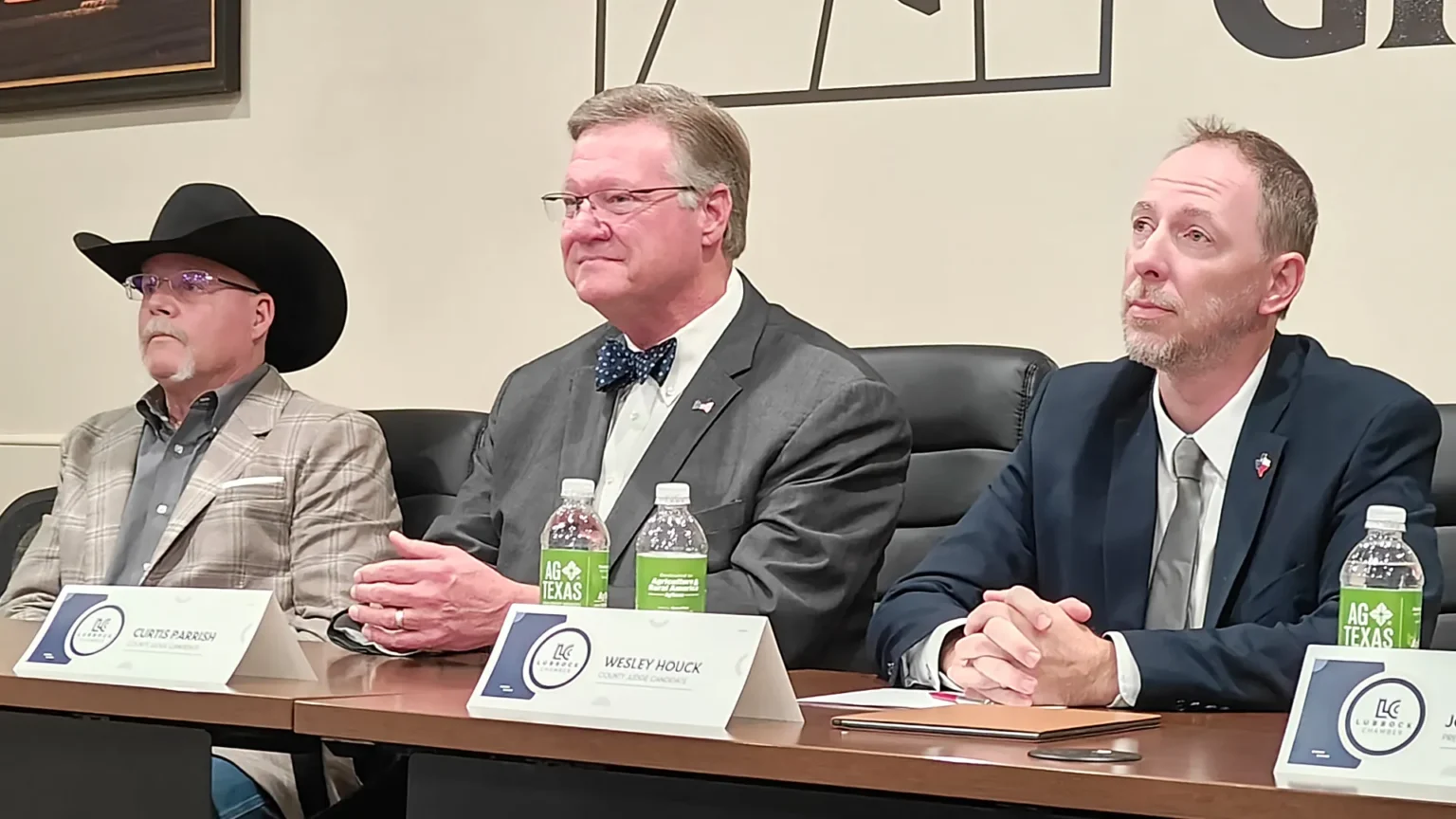
Curtis Parrish defended the county’s record and planning efforts, while challenger Wesley Houck argued that division and unclear priorities were slowing progress.
The two Republican candidates for Lubbock County judge presented sharply different assessments of local government during the 2026 primary campaign.
Incumbent Curtis Parrish, who was seeking a third term, argued that Lubbock County had made substantial progress on public facilities, transportation and economic development. Challenger Wesley Houck, then a Wolfforth City Council member, said disagreements among county officials showed an absence of unified leadership and long-term planning.
Their differences emerged during a Jan. 9 forum hosted by Plains Cotton Growers and the Lubbock Chamber of Commerce and in subsequent interviews documented by Lubbock Lights.
The candidates competed in the March 3 Republican primary. Because no Democrat filed for the office, the Republican nominee was positioned to win the November election unless another candidate qualified.
Houck criticized discord on Commissioners Court
Houck said he decided to run after attending Lubbock County Commissioners Court meetings and observing what he described as contention, poor communication and a leadership vacuum.
He acknowledged that disagreements are normal among elected officials, but argued that the conflict went beyond ordinary policy debates. He said commissioners appeared to lack a common set of goals and a clearly communicated plan covering the next several years.
Houck compared those meetings with his experience on the Wolfforth City Council, where he said city departments and elected officials worked more cohesively.
The county judge presides over Commissioners Court but does not control it independently. The judge and four commissioners each have one vote, meaning any countywide agenda requires support from a majority of the court.
Parrish said some of the conflict arose from a fundamental disagreement over taxes and spending. Several commissioners had pushed for the no-new-revenue property-tax rate while also supporting spending on county employees, public safety and major construction needs.
Parrish argued that officials could not continually reduce revenue while expanding services and capital spending.
Candidates agree infrastructure needs attention
Despite their disagreement over leadership, both candidates identified aging infrastructure as one of the county’s most urgent challenges.
Lubbock County had recently completed a new regional medical examiner’s facility on the city’s north side, financed through bonds approved by voters in 2023. Construction was also underway on a neighboring Texas Anti-Gang Center facility supported by a state grant.
Other projects remained unresolved.
The county office building at 916 Main St. required millions of dollars in renovations, with first-floor work alone expected to exceed $2 million. Officials had also discussed replacing the adjacent parking garage at an estimated cost approaching $8 million.
Additional needs included repairs at the Lubbock County Detention Center, a possible jail expansion, replacement of the adult probation building and relocation of justice of the peace and constable offices from the courthouse into their respective precincts.
Parrish said population growth made those projects increasingly important. He cited demographic projections suggesting Lubbock County could approach 500,000 residents by 2040 and said the county needed to prepare its roads, jail, courthouse, parks and other facilities.
He pointed to an ongoing facilities assessment as evidence that county officials were examining what should be repaired, replaced or expanded. Parrish acknowledged that many costs and final decisions had not yet been established.
Houck said assessments were not a substitute for a publicly understandable capital plan. He wanted the county to identify its priorities across all four precincts, divide large projects into manageable stages and establish a timeline for completing them.
Transparency becomes another dividing point
Houck questioned whether commissioners and residents had a clear understanding of the county’s financial position. He said conversations with county officials left him uncertain about whether spending figures and future obligations were being communicated consistently.
His first step as county judge, Houck said, would be to clarify the budget, determine where money was being spent effectively and identify expenses that could be reduced.
Parrish rejected the suggestion that Lubbock County’s finances were unclear. He pointed to recognition received through the Texas Comptroller’s Transparency Stars program, which evaluates whether local governments publish budgets, financial reports, downloadable data and other accountability information.
Lubbock County’s own financial-transparency records state that it received a Transparency Star for traditional finances in 2024.
The award verifies that the county met the comptroller’s publication criteria, though it does not settle the candidates’ broader disagreement over whether the budget and long-term plans were sufficiently clear to commissioners and the public.
Different views of the county judge’s job
The candidates also disagreed over how the county judge should divide time between administrative and judicial duties.
Unlike many county executives outside Texas, the Lubbock County judge has both responsibilities. The judge presides over Commissioners Court while also handling probate, guardianship and certain mental-health proceedings. The county’s official description of the office includes hearings involving estates and incapacitated residents.
Houck characterized the position as roughly divided between judicial and administrative work. He said uncontested judicial matters could be handled efficiently, allowing the judge to spend more time building relationships, coordinating commissioners and managing county business.
Parrish said judicial responsibilities occupy a substantially larger share of the job—about 65% in his experience. He emphasized that probate and guardianship cases frequently involve families confronting death, disability or incapacity and therefore require careful attention.
Parrish, an attorney who practiced probate and guardianship law before taking office in 2019, presented that experience as a major qualification. On the administrative side, he cited his involvement in projects such as the Leprino Foods plant, West Texas State Veterans Cemetery, Loop 88 and regional transportation planning.
Houck emphasized his business background and service on the Wolfforth City Council. He argued that the county judge’s most important administrative contribution should be creating relationships that allow independently elected commissioners to reach compromises.
The race ultimately offered Republican voters two different diagnoses: Parrish maintained that the county had a growth-oriented vision but faced difficult revenue choices, while Houck argued that the missing ingredient was a more unified and transparent planning process.
Election update: Official Lubbock County results show that Parrish won the March 3 Republican primary.