

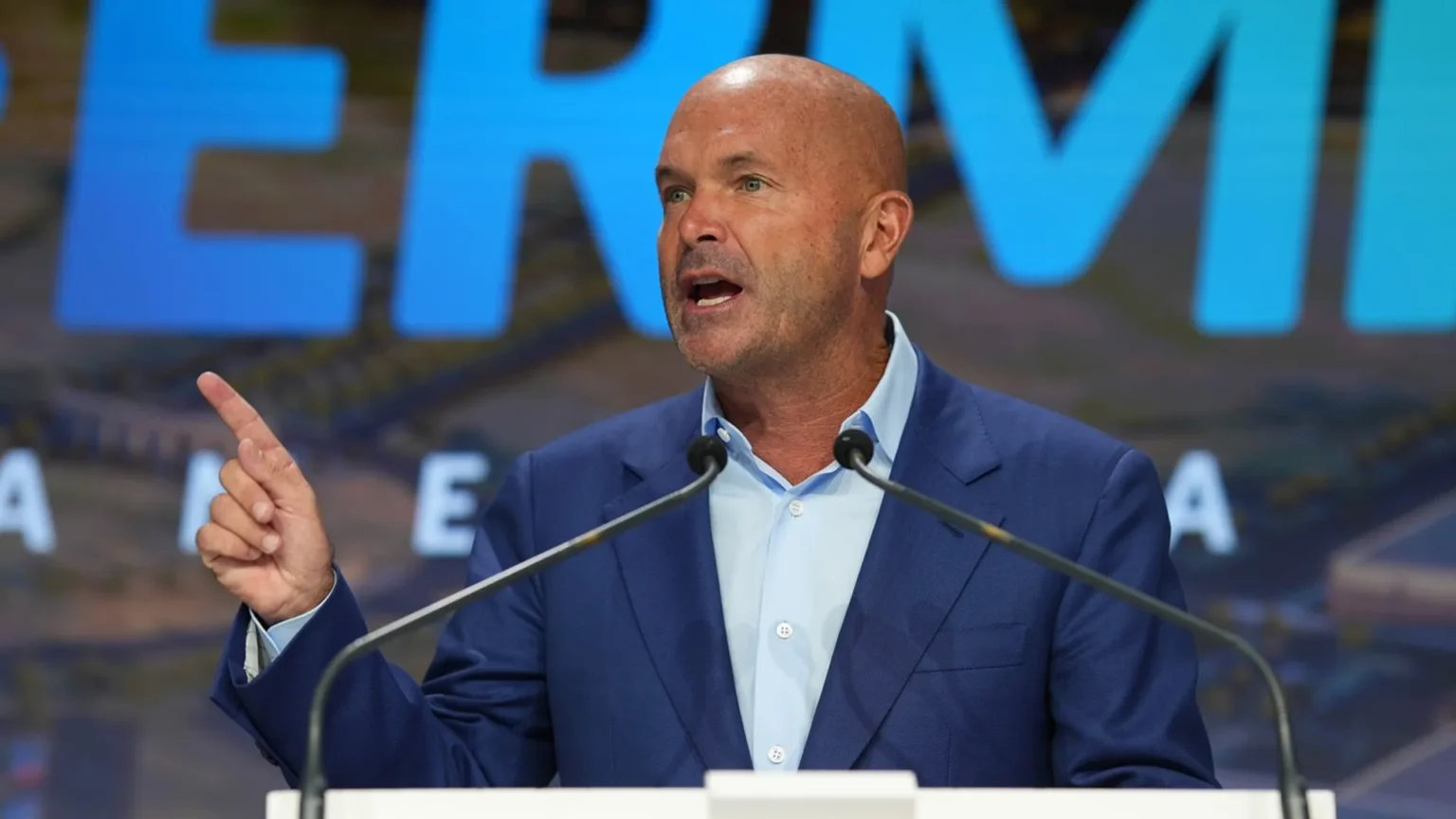
Toby Neugebauer has suspended his campaign to overhaul Fermi Inc.’s board, temporarily ending a public struggle over control of the company developing a massive energy and artificial-intelligence campus on land connected to the Texas Tech University System.
The decision stops Neugebauer’s current effort to collect shareholder authorizations for a special meeting. It does not settle his court fight with Fermi, resolve the dispute over his removal or determine the future of Project Matador.
Neugebauer, a Fermi co-founder, former chief executive and major shareholder, had sought to install a new group of directors who would consider both continuing the company’s independent development plan and exploring a sale or strategic partnership.
In a July 3 filing with the Securities and Exchange Commission, Neugebauer’s group said it had withdrawn the solicitation because the presiding Texas Business Court judge recused himself shortly before a scheduled hearing. The filing said the group would not act on shareholder authorizations already received unless the campaign was resumed.
Neugebauer said the judicial delay made it impossible to seat new directors quickly enough to supervise what he called a “dual-track” process. That strategy would have continued efforts to build Project Matador and secure tenants while simultaneously testing whether another company would pay shareholders more by acquiring or partnering with Fermi.
He said he would continue challenging the company’s governance decisions in court, including a bylaw change requiring a 70% vote for certain changes involving the size and composition of Fermi’s board.
Fermi portrayed the suspension differently. The company declared that the campaign had failed and that no special shareholder meeting would occur.
Neugebauer said more than 70% of the votes cast in his solicitation supported calling a special meeting. Fermi responded that, based on its preliminary count, he had obtained authorizations representing approximately 31% of all outstanding shares, while revocations represented about 36.4%.
Those percentages describe different measurements: Neugebauer cited the share of votes submitted in his campaign, while Fermi compared authorizations and revocations with the company’s entire outstanding share count. The company said the solicitation would have fallen short of the threshold required to call a meeting.
The competing accounts are part of a broader dispute that began after Fermi’s board removed Neugebauer as CEO on April 17. A board committee subsequently said it terminated his employment for cause and removed him as a director.
Fermi has alleged that Neugebauer engaged in misconduct, made misrepresentations to the board and damaged relationships with potential business partners. Neugebauer disputes the company’s version, has described his removal as unjustified and has accused directors of entrenching themselves.
Those remain contested corporate and legal claims; the proxy campaign’s suspension did not resolve them.
What the fight was about
Neugebauer’s original proxy materials filed with the SEC sought to add directors who would evaluate strategic alternatives, including a possible sale.
He argued that Project Matador’s land, permits, power-generation plans and long-term agreements were worth substantially more than Fermi’s market valuation. A buyer with lower financing costs, construction experience and a major technology customer might be able to complete the project with less risk, he said.
Fermi’s board opposed that strategy, arguing that an immediate sale could transfer the company at a depressed value before management had secured a major tenant. Its directors said the company should instead continue developing the campus, recruit a permanent CEO, obtain binding customer commitments and explore partnerships without putting the entire business up for sale.
The board also said a special meeting would distract management from Project Matador’s financing, construction and tenant negotiations. Neugebauer countered that new oversight was needed precisely because of those challenges.
Texas Tech agreement remains in place
Project Matador is planned for Carson County, northeast of Amarillo. Fermi envisions a campus combining data centers with natural-gas generation, nuclear energy, solar power, battery storage and connections to the electric grid.
The Texas Tech University System announced its collaboration with Fermi in June 2025, initially describing an approximately 5,800-acre campus with up to 11 gigawatts of capacity. Fermi later said the broader site could grow to approximately 7,570 acres and support as much as 17 gigawatts, subject to additional land acquisitions and regulatory approvals.
Fermi’s SEC disclosures show that it entered into a 99-year ground lease with Texas Tech for land intended for Project Matador. The parties signed another collaboration agreement in March 2026 expressing their intention to continue working together.
The proxy fight did not cancel that lease or Texas Tech’s relationship with Fermi. However, the project must still satisfy significant conditions.
According to Fermi’s quarterly filing for the period ending March 31, the company must receive a notice to proceed from Texas Tech before beginning vertical construction of data-center facilities on the leased site. Conditions include financing for the first phase, required permits and an executed lease with a first-phase tenant for at least 200 megawatts.
The filing said the notice to proceed must be obtained by Dec. 31, 2026. Fermi also agreed to make a $2 million advance rent payment and place another $9 million in escrow before the end of the year.
Those requirements mean the project’s future depends less on the paused proxy campaign than on Fermi’s ability to secure a binding tenant, preserve liquidity, obtain construction financing and meet its obligations under the Texas Tech lease.
What happens next
Fermi says its present board and leadership team will concentrate on securing a tenant, hiring a permanent CEO, delivering power to the site and finding strategic partners. The company continues to describe Project Matador as commercially valuable and says development is progressing.
Neugebauer also says he remains confident in the project, despite suspending his current shareholder campaign. His SEC filing leaves open the possibility of renewing the solicitation, while his court case over Fermi’s governance continues.
For Texas Tech, the immediate result is continuity rather than certainty. Its lease and collaboration with Fermi remain active, but the project’s promised scale will depend on milestones that have not yet been completed.
The boardroom battle has therefore paused without answering the central question: whether Fermi can convert its ambitious plans, permits and long-term land rights into a financed data-center campus with committed customers.