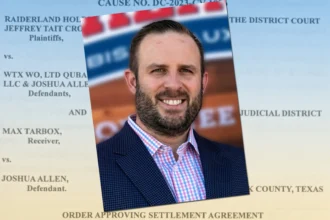



Retired visiting Judge Patrick Pirtle is overseeing the case after the original judge recused himself.
LUBBOCK, Texas — Lubbock County has denied allegations that commissioners exceeded their authority when they imposed tighter restrictions on game rooms, but a temporary agreement now prevents the county from enforcing two disputed provisions while the lawsuit remains pending.
El Fronteriso Entertainment LLC filed the case March 2 after county commissioners amended Lubbock County’s game-room ordinance. The business argues that the new restrictions are unconstitutional, exceed the authority granted to counties by Texas law and impose an unreasonable burden on otherwise lawful operations.
In its formal answer filed March 19, Lubbock County issued a general denial of every allegation and demanded that El Fronteriso prove its claims.
The two-page filing did not offer a detailed response to each legal argument. It asked the court to dismiss the county from the case, order that the plaintiff receive nothing and allow the county to recover its legal costs.
A general denial is a routine pleading that preserves a defendant’s ability to contest the allegations. It is not a judicial finding that the county acted legally, nor does it resolve any of El Fronteriso’s claims.
Lawsuit challenges hours, signs and security requirement
El Fronteriso, owned by Eric Thompson, filed the case as the county began enforcing amendments approved in February.
The original lawsuit challenged several parts of the revised ordinance:
- Game-room operating hours were reduced from 97 hours per week to 45. The amended rules allowed operation only from 8 a.m. to 5 p.m., Monday through Friday.
- Businesses were required to keep entrance doors unlocked while open, which El Fronteriso described as a security risk.
- Game rooms were required to display a sign stating that gambling is illegal in Texas.
- The lawsuit alleged commissioners violated the Texas Open Meetings Act by failing to provide adequate public notice that operating hours would be changed.
- El Fronteriso characterized the restrictions as a regulatory taking of its business interests without compensation.
The business is seeking declaratory and injunctive relief rather than monetary damages. It wants the court to declare the challenged amendments invalid and prevent the county from enforcing them.
Lubbock County’s February amendment states that the restrictions are intended to reduce what county officials describe as negative secondary effects associated with game rooms, including gambling offenses and other criminal activity.
Dispute centers on the limits of county authority
Chapter 234 of the Texas Local Government Code gives qualifying counties authority to regulate game-room operations to promote public health, safety and welfare.
The law specifically allows counties to regulate locations, limit the number of game rooms in an area, require permits, conduct inspections and impose penalties. The dispute is whether that authority extends to all the operational restrictions Lubbock County adopted and whether the county followed the required procedures.
El Fronteriso maintains that its games fall within an exception in Section 47.01 of the Texas Penal Code. That provision excludes certain bona fide amusement machines from the definition of a gambling device when they award only low-value, noncash merchandise, toys or novelties.
The provision is commonly called the “fuzzy animal” exception. It generally limits the wholesale value of a prize from one play to no more than 10 times the cost of playing or $5, whichever is less.
That exception does not automatically make every eight-liner or amusement machine lawful. A June 2026 Texas attorney general opinion concluded that a machine can still qualify as a gambling device when chance plays a role in determining whether the player receives something of value. The opinion does not decide the El Fronteriso lawsuit or make a factual finding about the machines used by the business.
Visiting judge assigned after recusal
The lawsuit was filed in Lubbock County’s 237th District Court and was initially assigned to Judge Les Hatch. Hatch later recused himself.
Ana Estevez, presiding judge of the Ninth Administrative Judicial Region, reassigned the case to retired visiting Judge Patrick Pirtle. Publicly available records did not state a reason for Hatch’s recusal.
Pirtle is now responsible for overseeing discovery, deciding pretrial issues and conducting any eventual trial.
Temporary agreement expands operating hours
On April 24, Pirtle signed an agreed temporary order negotiated by El Fronteriso and the county.
Under that order, Lubbock County cannot enforce the amended 8 a.m.-to-5 p.m. weekday schedule against permitted game rooms as long as they operate only between 10 a.m. and 10 p.m. The temporary schedule applies seven days a week, allowing a maximum of 84 operating hours.
The county also agreed not to enforce the ordinance provision requiring game rooms to display a sign stating that gambling is illegal in Texas.
Other portions of the ordinance remain in effect, including permitting, employee screening, security and inspection requirements. The agreement does not declare either side the winner. It temporarily determines what the county may enforce until another court order is entered or the case is resolved.
Game-room permits have declined
The lawsuit comes amid a broader reduction in game-room operations in unincorporated Lubbock County.
As of June, the county reported 23 game rooms with valid permits, compared with 45 in August 2025. Fourteen permits had been revoked or were not renewed, according to records reviewed by Lubbock Lights.
Some revocations involved businesses that ceased operating without providing the notice required by the ordinance. The county has also created a citizen board to hear appeals involving denied or revoked permits.
The El Fronteriso case remains pending. No final ruling has determined whether the challenged amendments are lawful, and the temporary order will remain effective until the court changes it or resolves the underlying dispute.