

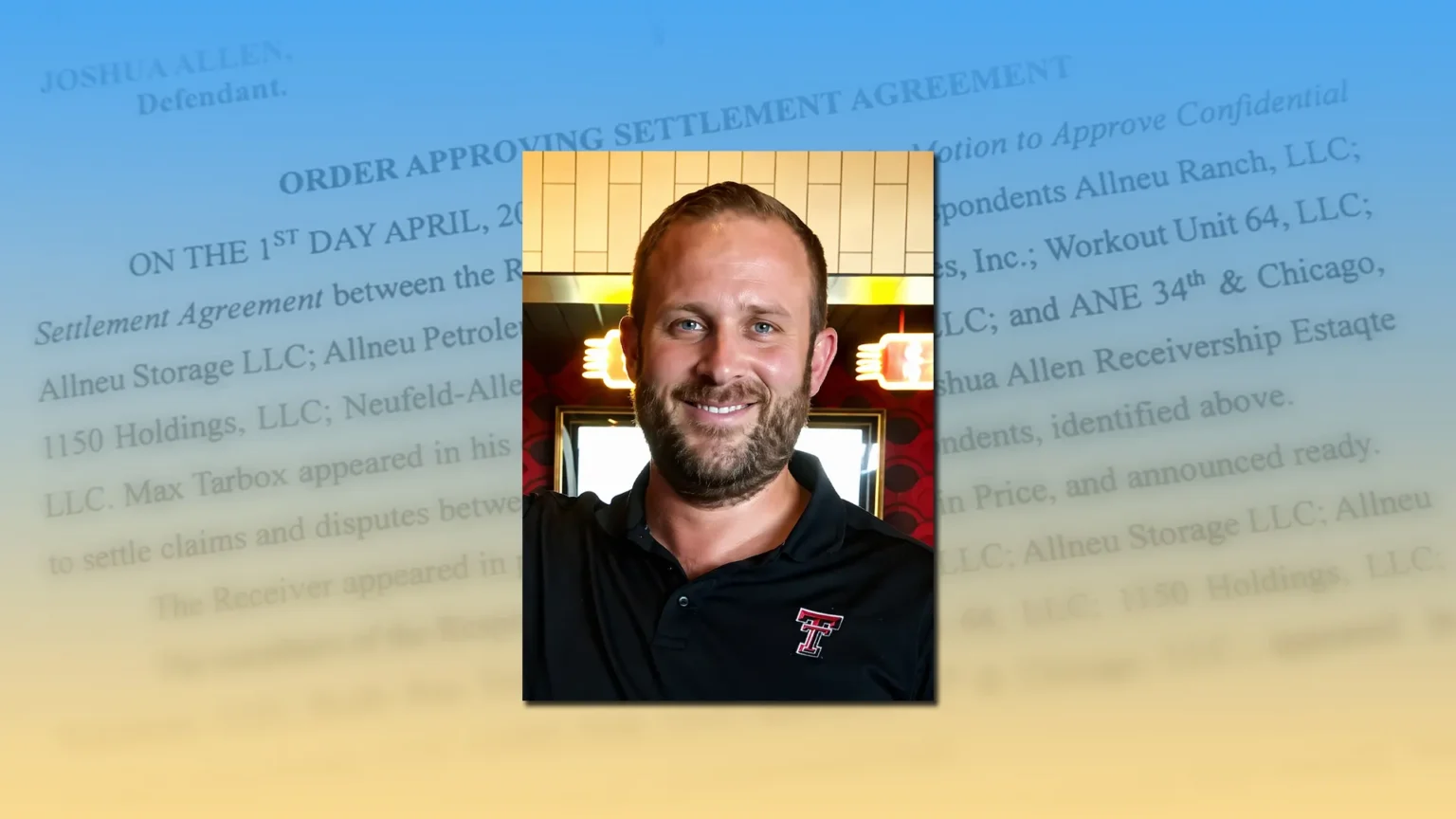
Information uncovered by a Lubbock receiver could help the Ferrum Capital receivership trace property, but identifying an asset does not guarantee that investors can recover it.
LUBBOCK, Texas — Information gathered while collecting an unrelated judgment against Joshua Allen may give the Ferrum Capital receivership additional places to search for assets that could potentially compensate investors.
Lubbock attorney Max Tarbox gained control of Allen’s non-exempt property and business interests after being appointed receiver in a lawsuit involving investors in an Amarillo Walk-On’s Sports Bistreaux. During that assignment, Tarbox identified more than 20 limited liability companies that Allen had formed or in which he held an ownership interest.
Tarbox said he was willing to provide his records and notes to John Patrick Lowe, the court-appointed receiver overseeing Ferrum Capital and related entities in a separate San Antonio civil case.
“I would give that information to the receivers in San Antonio,” Tarbox told Lubbock Lights in April.
Since those comments, Lowe has moved to restrict Allen’s ability to transfer numerous businesses and other holdings while the Ferrum litigation continues. A Bexar County judge granted that request in June, preserving assets that Lowe contends may eventually be available to the receivership.
The order does not establish that every named company contains Ferrum money or that every asset will be sold for investors’ benefit. Ownership, exemptions, liens and the source of money used to acquire each asset may still have to be determined.
Walk-On’s receiver gained access to Allen’s companies
Tarbox’s investigation began with a lawsuit filed by Jeffrey Tait Crow and Raiderland Holdings over the former ownership group behind the Amarillo Walk-On’s location.
State District Judge John Grace found in 2025 that Allen breached fiduciary duties owed to those investors and entered a judgment of approximately $575,000, plus attorney fees and interest. After the judgment remained unpaid, Grace appointed Tarbox and authorized him to take possession of Allen’s non-exempt property.
That authority included Allen’s membership and voting rights in privately held companies. Tarbox said he effectively stepped into Allen’s position when company members considered transactions involving those interests.
The receiver eventually negotiated an $835,000 settlement under which members of the Neufeld family purchased Allen’s stakes in nine businesses. The proceeds covered the Walk-On’s judgment, interest, attorney fees and receivership expenses.
Collection in that case was completed and the Lubbock receivership ended in May. The money went toward the Walk-On’s judgment; it was not distributed among Ferrum investors.
The importance of Tarbox’s work to the Ferrum proceedings lies instead in the business and ownership information he collected. That material could help Lowe identify companies, real estate or transfers that merit further investigation.
The two receiverships have different legal foundations. Tarbox was collecting a judgment for specific Walk-On’s plaintiffs. Lowe was appointed in litigation involving Ferrum Capital and is charged with preserving and recovering property for the broader Ferrum receivership estate.
Bexar County judge freezes Allen-linked holdings
Lowe later asked a Bexar County court to stop Allen from transferring or disposing of businesses and related property. The request argued that the end of the Walk-On’s receivership left Allen free to move assets that had previously been under Tarbox’s control.
Lowe alleged that a forensic accounting investigation showed Ferrum operated as a Ponzi scheme and that Allen received millions of dollars in fraudulent transfers. The receiver estimated that Allen caused at least $11 million in damage to the Ferrum companies and at least $50 million in losses to plaintiffs in the civil case. Those figures are allegations in the receivership litigation and are separate from any final recovery calculation.
On June 12, Judge Norma Gonzales of the 131st District Court issued a temporary injunction restricting Allen, Allen Financial Agency and Landzacha Holdings from selling, transferring or dissipating covered assets.
According to KCBD’s report on the injunction, the order reaches more than 35 businesses and holdings associated with Allen, including RaiderLand Property Management, Hub City Land, 7 Spur Ranch, Hub City Cantina and Monarch Executive Protection Services.
The judge found that Allen and the associated entities were probably insolvent and that the receivership faced an imminent risk of irreparable harm without an asset freeze. Those preliminary findings allowed the court to preserve the property while the civil claims proceed; they are not a final judgment establishing ownership or the amount ultimately owed.
An injunction prevents assets from disappearing during litigation. It does not automatically transfer them to investors. Lowe may still need to trace Ferrum funds, challenge allegedly fraudulent transfers, establish the receivership’s legal interest and resolve competing claims from lenders, co-owners or other creditors.
Investors must file a separate receivership claim
Potential recovery also depends on investors submitting claims through the court-approved Ferrum process.
Ferrum investors have until 5 p.m. Sept. 3, 2026, to deliver a completed claim form to the receiver. Non-investor creditors face an earlier deadline of Aug. 3.
A claim previously filed in Michael Cox’s bankruptcy, the Collins Asset Group bankruptcy or another lawsuit does not substitute for a Ferrum receivership claim. The court notice describes the process as the exclusive method for seeking a distribution from the receivership estate.
Forms and instructions are available through the Ferrum claim-process report. Filing a claim preserves the claimant’s right to be considered, but it does not guarantee payment or full reimbursement. Any distribution will depend on how much property Lowe recovers, the cost of administering the receivership and the number and priority of approved claims.
Criminal case remains separate
Allen and Ferrum co-founder Michael Cox also face federal criminal charges, including securities fraud and conspiracies involving wire fraud and money laundering. They have pleaded not guilty, and the allegations against them must be proven beyond a reasonable doubt.
The federal indictment and Justice Department announcement allege that hundreds of investors lost millions after money intended for investments was instead used to benefit insiders or pay earlier investors.
Their trial is scheduled to begin Aug. 10 in San Antonio. Former affiliate Brooklynn Chandler Willy pleaded guilty in March to 10 federal charges related to investment fraud and is awaiting sentencing.
The criminal prosecution, civil receivership and bankruptcy cases may all affect victims, but they are legally distinct. For now, Tarbox’s discoveries and Lowe’s asset freeze expand the pool of property investigators can examine—not the amount investors are certain to receive.