

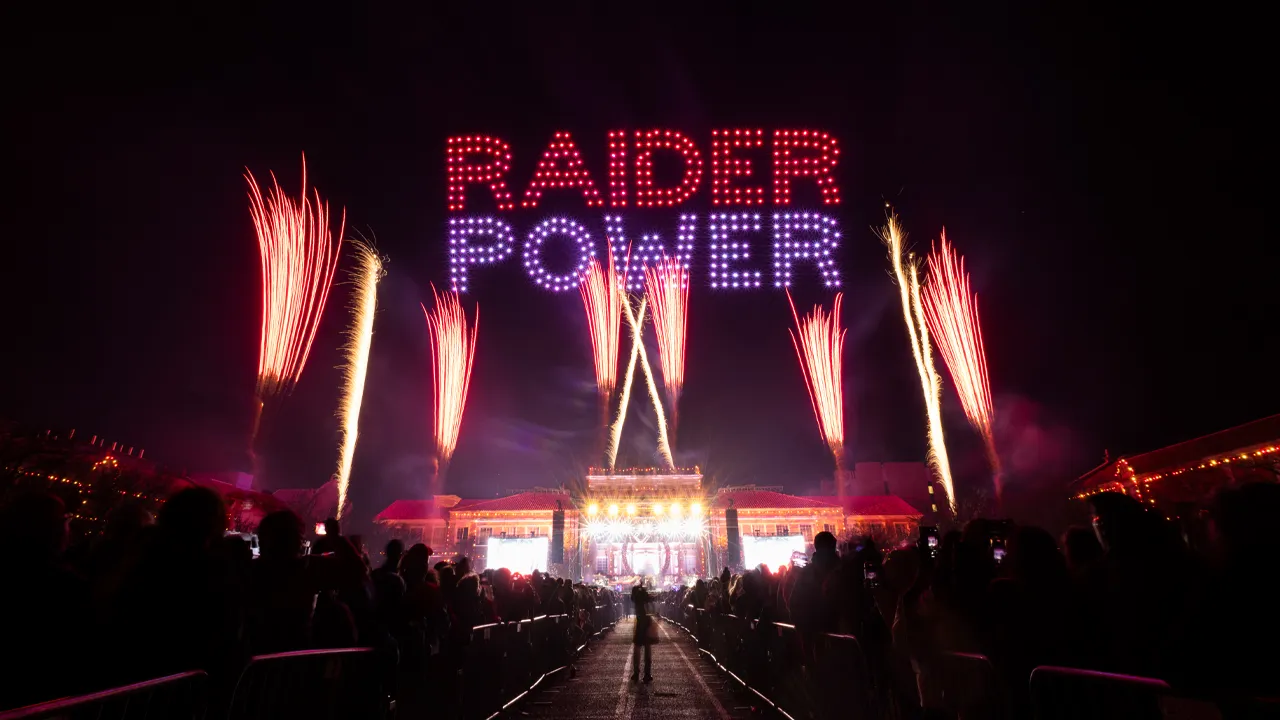
LUBBOCK, Texas — Hundreds of illuminated drones transformed the night sky above Texas Tech University into a moving display of Red Raider traditions during the 2023 Carol of Lights. What spectators could not see was how close the ambitious production came to being canceled.
The full-length, choreographed drone show was the finale of Texas Tech’s yearlong centennial celebration and a major addition to the university’s 65th annual Carol of Lights. More than 400 drones created animated images ranging from Raider Red in a Santa hat to the Masked Rider racing through the sky on a glowing Rudolph.
Hours before the performance, however, powerful West Texas winds threatened to ground every drone.
High winds placed the show in jeopardy
Drone shows can operate only within strict weather limits. According to Blayne Beal, Texas Tech’s director of centennial coordination at the time, sustained winds needed to remain below 20 mph, while gusts had to stay under 30 mph.
Earlier on Dec. 2, 2023, Lubbock recorded a gust of 61 mph. Conditions like that would have made the performance impossible.
The university and its drone contractor had little choice but to monitor the weather and wait. By the time the show was scheduled to begin, the wind had weakened enough for the drones to take flight.
The improvement rescued a production that had become one of the most expensive and visible parts of Texas Tech’s centennial. Beal did not provide an exact price but told Lubbock Lights that its cost was well into six figures.
A finale five years in the making
Texas Tech began planning its centennial celebration approximately five years before the university’s 100th anniversary. The program opened at the 2022 Carol of Lights and ended one year later at the same campus tradition.
Approximately 40 events took place between the two ceremonies. They included the Goin’ Band from Raiderland’s appearance in the Macy’s Thanksgiving Day Parade, a Texas Tech presentation at the state Capitol and recognition at the State Fair of Texas.
The university also challenged Red Raiders to contribute 1 million hours of community service.
Organizers wanted the final event to demonstrate how far the institution and the Carol of Lights had grown. The original gathering began in 1959 with about 5,000 lights and a small group of students singing Christmas carols. By 2023, the celebration featured approximately 25,000 lights and routinely attracted more than 20,000 people, according to a Texas Tech history of the tradition.
The university had introduced fireworks during the previous year’s celebration. For the centennial finale, organizers wanted an even larger visual attraction.
In addition to fireworks and the drone display, the 2023 program featured Lost Wax, Annie Chalex Boyle, Mariachi Los Matadores, aerial performers and Texas Tech’s combined choirs. The university promoted the event as the largest and most elaborate Carol of Lights in its history.
Turning Red Raider symbols into aerial animations
Coca-Cola, which presented the Carol of Lights and sponsored Texas Tech’s centennial celebration, paid for the drone show, Beal said. The university then worked with North Richland Hills-based Sky Elements Drone Shows to create the performance.
Designing the display began on a computer rather than in the sky. Each drone initially appeared as a white dot in a digital rendering. Designers used those dots to establish the location and movement of every aircraft.
The production then progressed to a full-color simulation showing how the lights would change, fade and move throughout the performance. This allowed organizers to watch a virtual version of the entire show before the drones arrived in Lubbock.
The images combined Christmas themes with familiar Texas Tech symbols. Designs included the centennial logo, “Wreck ’Em Tech,” “Raider Power,” a Guns Up hand creating a snowflake and Raider Red wearing a Santa hat.
One of the most memorable sequences began with a design problem. Organizers wanted to show the Masked Rider galloping across the sky, but a black horse did not stand out against the dark background. The team solved the problem by turning the horse into Rudolph, complete with a bright red nose.
The animated result became Beal’s favorite part of the show.
Safety required an empty area around the drones
Texas Tech created a secured launch and flight zone on campus, surrounded by an additional buffer area. Security personnel prevented spectators from entering the restricted space.
That separation was necessary in case a drone malfunctioned, left formation or was pushed off course by a sudden gust. Keeping the public outside the area reduced the risk of an aircraft falling near spectators.
Despite the production’s complexity, there was no full outdoor rehearsal in Lubbock. The Sky Elements team arrived on the day of the event, relying on its computerized programming and pre-show preparations to coordinate the flight.
The performance was not technically Lubbock’s first experience with an organized drone display. Texas Tech had previously used about 200 drones during a football game against TCU, but that demonstration lasted only about 45 seconds and showed three images. The Carol of Lights production was the city’s first complete, continuously choreographed drone show, according to Beal.
Texas Tech had announced before the event that more than 400 drones would participate, setting expectations for a record-sized Lubbock display.
The wind nearly prevented that promise from being fulfilled. Instead, conditions improved just in time, allowing years of centennial planning to conclude with Red Raider symbols moving across the December sky.