


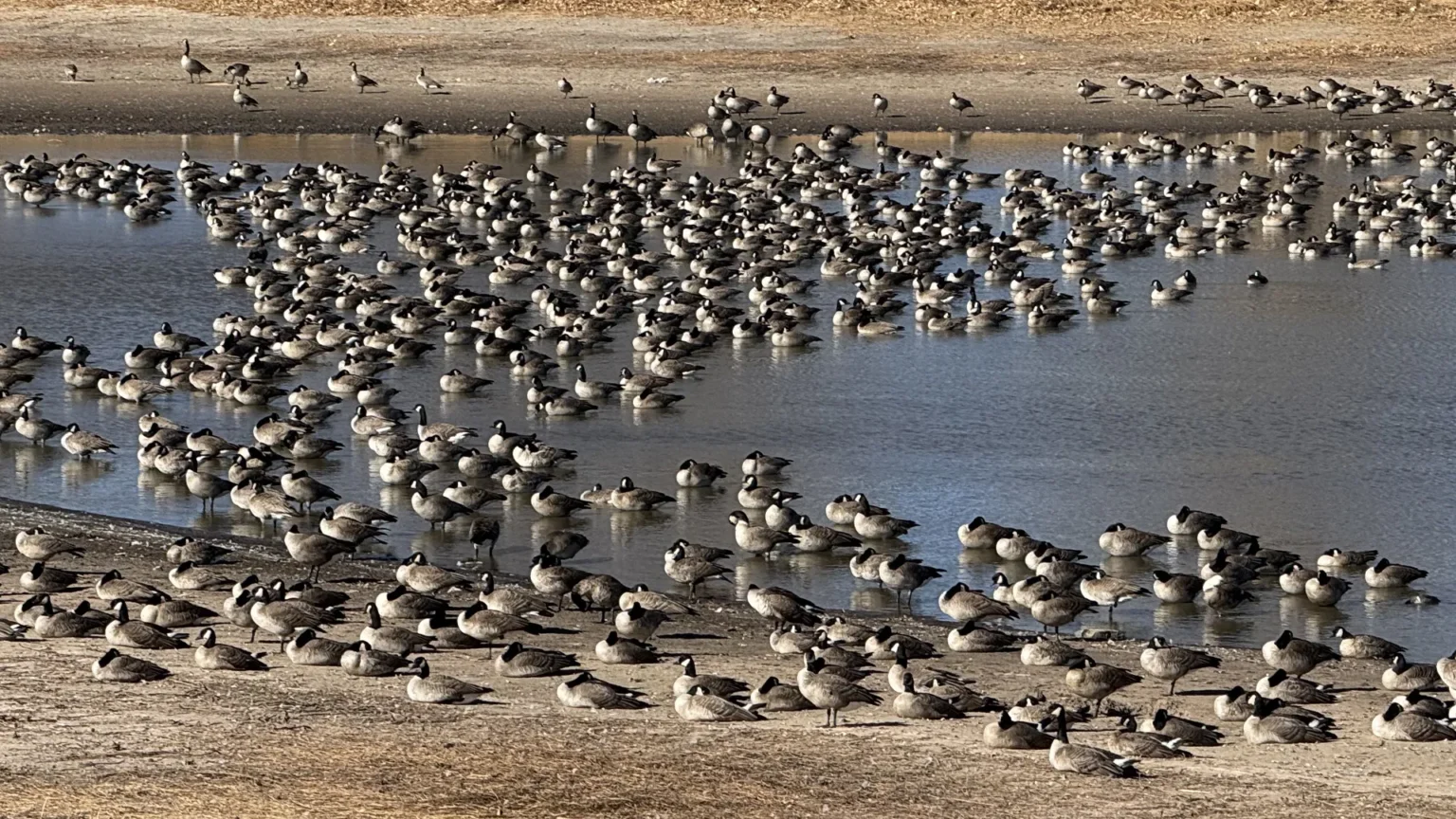
Warm weather and drought kept many migratory birds farther north, while limited water concentrated those reaching Lubbock in urban lakes.
Lubbock’s playa lakes appeared unusually crowded with Canada geese during the winter of 2025–26, but wildlife specialists said the packed shorelines created a misleading impression.
The total number of migratory geese reaching the region was actually lower than usual. The birds that did arrive were gathering in fewer places because drought had left less water available across the surrounding countryside.
“They’re more concentrated because there’s less water on the landscape,” Heather Johnson, a migratory game bird biologist with the Texas Parks and Wildlife Department, told Lubbock Lights.
That concentration made parks and neighborhood lakes look busier even though many geese had not completed their normal southward migration.
Warm winter kept birds farther north
Lubbock experienced unusually warm and dry conditions during the first half of January 2026. The average daily high for the first 14 days was 68 degrees, compared with a normal high of approximately 54 degrees. The U.S. Drought Monitor classified the greater Lubbock area as experiencing moderate to severe drought.
At the same time, relatively mild conditions in states farther north allowed many geese and other waterfowl to remain in Montana, Colorado and Nebraska.
Johnson said approximately half of the migratory birds typically found around Nebraska’s Platte River had remained there instead of continuing south to Texas. A complete winter waterfowl survey was not yet available, so no official total for the Lubbock region had been published.
The behavior is consistent with a broader change documented by bird researchers. The Cornell Lab of Ornithology reports that some Canada goose populations are wintering farther north because of weather, changes in hunting pressure and increased access to waste grain from agricultural fields.
Migration requires considerable energy. If birds can find open water and sufficient food farther north, they have little incentive to continue hundreds of miles south. More severe cold, snow or frozen water can push them toward Texas later in the season.
Urban playa lakes provide dependable water
Although drought reduced water across rural areas, Lubbock’s urban playa lakes continued to offer comparatively reliable habitat.
Playas are shallow, rounded depressions located at the lowest points of watersheds. Their clay-lined basins collect rainfall and runoff, creating temporary wetlands across the High Plains.
Many urban playas have been modified to manage stormwater. Excavation and drainage systems allow them to receive runoff from streets, parking lots and developed neighborhoods. Consequently, they can remain wet longer than playas surrounded by farmland or undeveloped land.
Geese quickly find those remaining pockets of water. City lakes also offer protection from several threats the birds encounter in rural areas.
Hunting is generally not permitted around municipal lakes, and urban locations often have fewer large predators. Canada geese have gradually learned to use parks, golf courses and drainage lakes as safe nighttime roosts.
The abundance of maintained grass provides another attraction. According to the Cornell Lab’s Canada goose profile, the birds graze on grass, eat grain in agricultural fields and feed in shallow water.
Crowding increases competition and disease risks
Large numbers of birds occupying a limited amount of water can create problems. Food around the lake is consumed more quickly, waste accumulates and close contact makes it easier for diseases to spread through a flock.
Those concerns became particularly important after avian influenza was detected in wild birds in Lubbock and surrounding areas.
City officials warned residents not to pick up, feed or otherwise handle geese that appeared injured, disoriented or sick. The same precautions apply to dead birds.
The Centers for Disease Control and Prevention says bird flu remains widespread among wild birds but that the risk to the general public is considered low. The United States has reported 71 human A(H5) cases since 2024. Most infections have involved people with direct occupational or backyard-flock exposure to infected animals.
No sustained person-to-person transmission has been identified in the United States.
Johnson said residents should not take sick geese to wildlife rehabilitation facilities because doing so could expose people and other animals to infection. Reports had circulated locally about individuals touching or attempting to comfort distressed geese—behavior wildlife officials strongly discouraged.
Residents who encounter a dead or visibly ill bird should keep children and pets away and contact Lubbock Animal Services. People should not attempt to capture or transport the animal themselves.
Playas remain essential to the High Plains
Despite the complications created by large urban flocks, playa lakes are critical to wildlife throughout the region.
Anne Bartuszevige, conservation science director for the Playa Lakes Joint Venture, described the basins as biodiversity centers. When filled with water, playas produce plants, seeds and aquatic invertebrates that feed migrating birds and other animals.
The Playa Lakes Joint Venture also identifies playas as a major source of groundwater recharge. Water can move through cracks that develop in the clay floor when a playa dries.
That process means both wet and dry periods serve an ecological purpose. Water-filled playas provide temporary habitat, while dry periods allow the clay to crack so future rainfall can move toward the underlying aquifer.
Drought, however, leaves migrating birds with fewer feeding and resting locations at any one time. The remaining wet lakes then absorb much of the pressure.
That combination explains the apparent contradiction in Lubbock: fewer geese reached the area during the warm winter, but those that arrived were much more visible because they gathered closely around the city’s dependable urban water.