


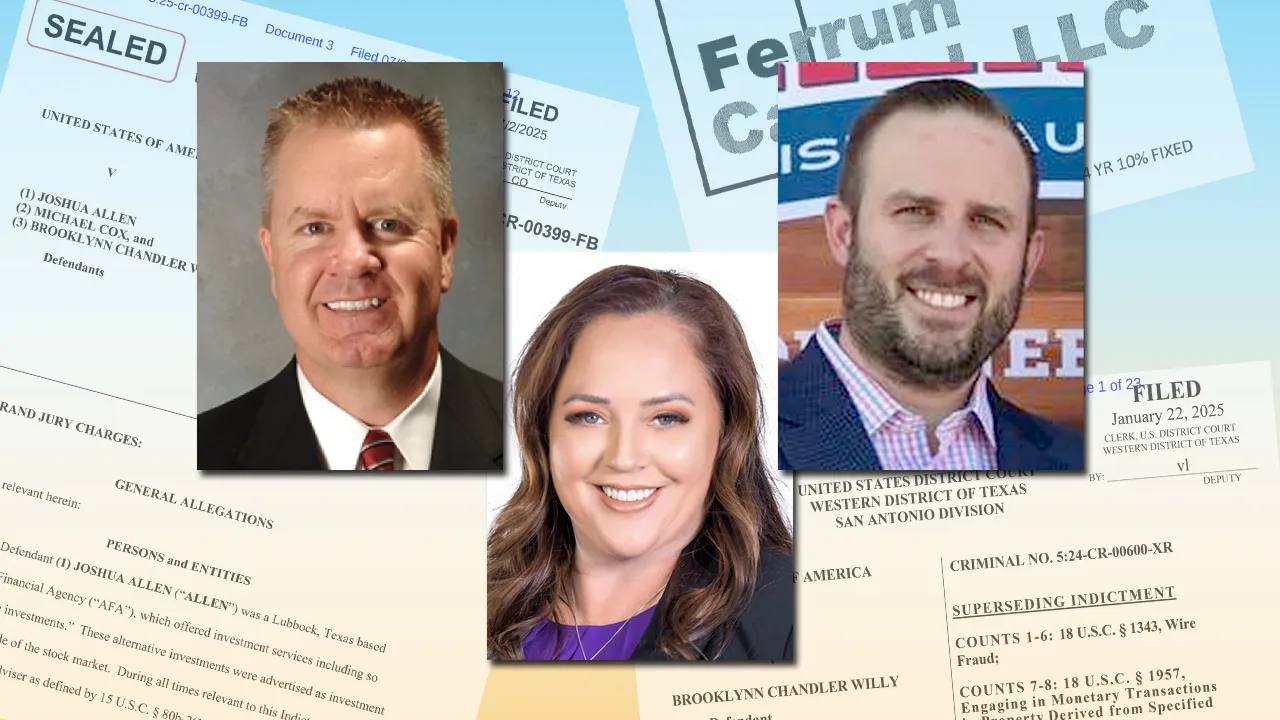
An April trial was postponed until August 10, but the judge later rejected another delay sought by Joshua Allen. Brooklynn Chandler Willy’s plea negotiations ended with guilty pleas to 10 federal charges.
The federal criminal case against Ferrum Capital co-founders Joshua Allen and Michael Cox remains scheduled for trial on August 10 in San Antonio, more than a year after prosecutors accused the Lubbock businessmen and financial adviser Brooklynn Chandler Willy of defrauding hundreds of investors.
The trial originally was scheduled for April 2026. U.S. District Judge Fred Biery postponed it after attorneys for the three defendants said they needed additional time to prepare and explore possible resolutions.
Biery determined that the additional preparation time outweighed the public’s and defendants’ interest in a speedy trial. The revised schedule established July 31 as the deadline for plea agreements and August 10 as the beginning of a trial expected to last several weeks.
At the time of the postponement, Willy was negotiating an agreement intended to resolve two federal cases pending against her. Prosecutors indicated that Allen and Cox were more likely to proceed to trial.
Those paths subsequently separated. Willy pleaded guilty on March 19 to 10 federal charges, while Allen and Cox continued to maintain their innocence.
Charges against the Ferrum founders
Allen and Cox jointly owned and controlled Ferrum Capital and three similarly named investment companies, according to the July 2025 federal indictment.
Federal prosecutors allege that Allen, Cox, Willy and others solicited investments while misrepresenting how the money would be used, the risks involved, the commissions paid to insiders and the collateral supposedly protecting investors.
The indictment alleges that hundreds of people invested approximately $67 million in Ferrum Capital. Investors were offered four-year notes paying either 8% interest quarterly or 10% annually at maturity. Prosecutors claim that, beginning in 2022, money from new investors was used to make redemption payments to earlier investors, pay commissions and benefit the defendants and their associates.
The allegations involve Ferrum Capital, Ferrum II, Ferrum III and Ferrum IV. Some money was intended for investments involving distressed debt, life-insurance settlements and other ventures, according to court records. Prosecutors contend that portions of the money were never invested as represented.
Allen, Cox and Willy were each indicted on four counts involving securities fraud and conspiracies to commit wire fraud and money laundering. The Justice Department’s announcement of the indictment stated that Allen and Cox could face a combined statutory maximum of 70 years in prison if convicted on every charge.
Maximum penalties do not predict the sentences defendants would receive. Any punishment would be determined by the judge after considering federal sentencing law, advisory guidelines and the circumstances of the case.
Allen and Cox pleaded not guilty. An indictment contains allegations, not findings of guilt, and both defendants are presumed innocent unless prosecutors prove the charges beyond a reasonable doubt.
Willy’s negotiations result in guilty pleas
Willy operated Queen B Advisory, which did business as Texas Financial Advisory, and Chandler Capital Holdings. She promoted Ferrum-related investments to clients, according to federal court filings.
When the trial was postponed in early 2026, prosecutors were negotiating with Willy to resolve both the Ferrum indictment and an earlier criminal case involving allegations of obstruction, false statements and identity theft.
On March 19, Willy admitted guilt to six counts of wire fraud and four additional charges: conspiracy to commit wire fraud, conspiracy to commit money laundering, engaging in a monetary transaction involving criminally derived property and aggravated identity theft.
According to a KCBD report detailing the pleas, prosecutors said one married couple invested through Willy in Ferrum Capital before later entrusting another $500,000 to a Ferrum-related opportunity. Willy admitted using that later investment for purposes including personal credit-card payments, payments to other investors and payments to another business she owned.
Willy’s sentencing was scheduled for September 28, after the anticipated Allen-Cox trial. Most of the offenses carry substantial potential prison terms, while aggravated identity theft requires a two-year sentence consecutive to any other punishment imposed.
Her guilty pleas do not establish Allen’s or Cox’s guilt. Prosecutors must separately prove their case against each man, and the defendants may challenge Willy’s credibility or any testimony she provides.
Further delay rejected
The August trial date later came under another challenge. Allen requested more time, arguing that asset restrictions affecting his business interests had interfered with his ability to pay defense attorneys.
Prosecutors opposed the request, saying arrangements could be made with the court-appointed receiver to release money for Allen’s legal defense. Biery ultimately rejected Allen’s request to postpone the trial again.
As the trial approaches, attorneys also are disputing what evidence jurors will be permitted to consider. Those pretrial questions can include the admissibility of other transactions, statements made by alleged co-conspirators and evidence concerning businesses connected to Ferrum.
The FBI and IRS Criminal Investigation are handling the federal investigation. The FBI also maintains an online form for people who believe they were affected by Ferrum-related investments.
Status update: As of July 24, 2026, Allen and Cox had not entered plea agreements, and their trial remained scheduled for August 10. Willy had pleaded guilty and was awaiting sentencing.