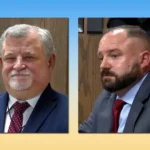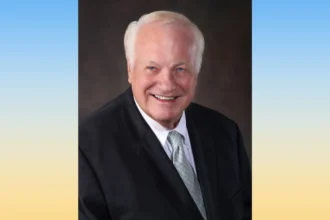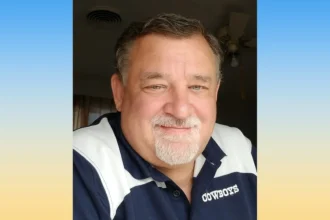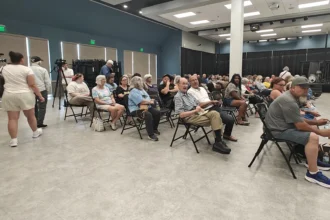


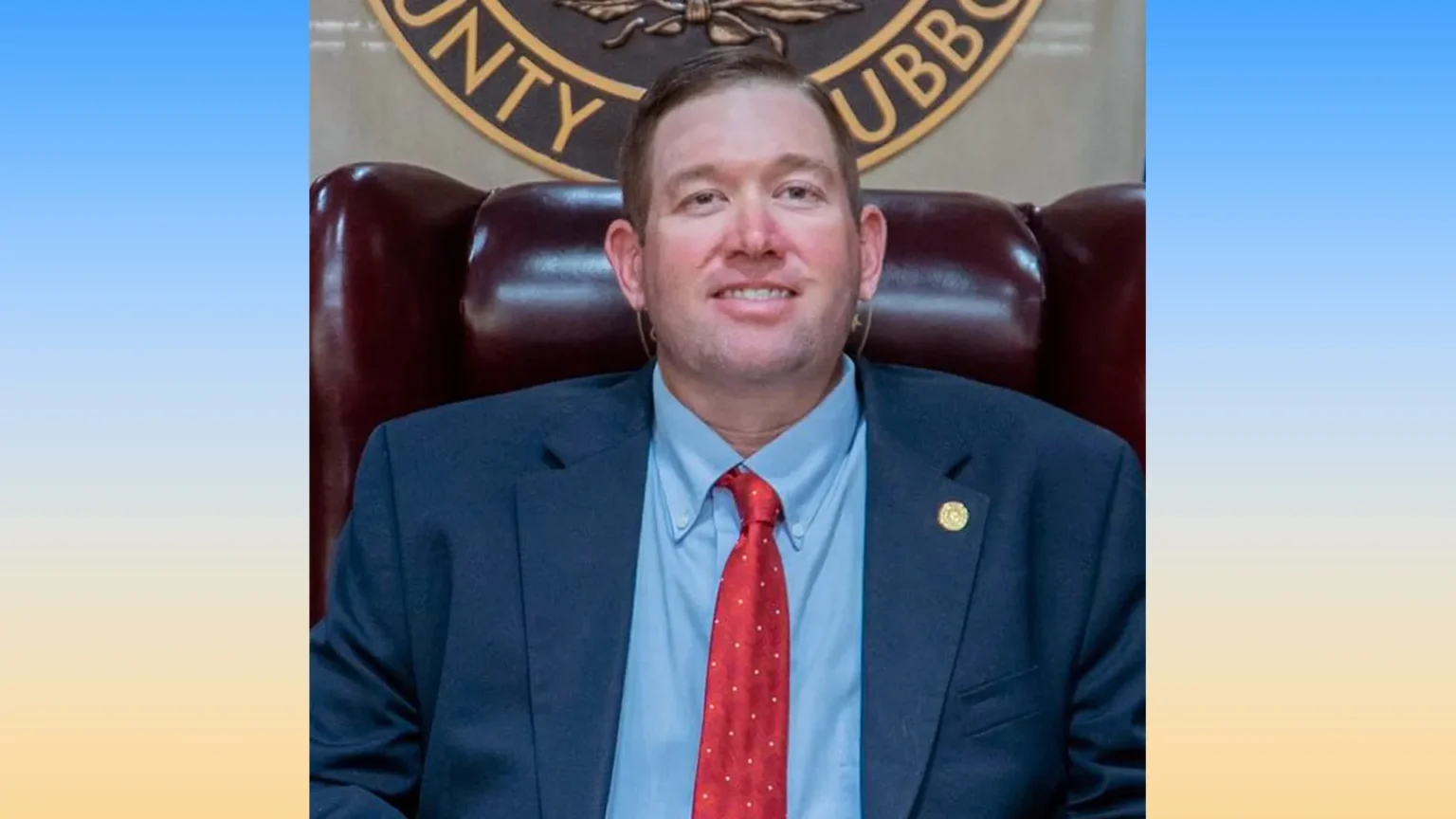
The Lubbock County commissioner defended his fiscal record and support for the long-planned event center while asking voters for another term.
Jordan Rackler entered the 2026 Republican primary asking voters to judge him by two of the most consequential issues of his first term: property taxes and the proposed Lubbock County Expo Center.
Rackler, who represents Precinct 4 on the Lubbock County Commissioners Court, presented himself as a responsive official willing to take firm positions even when those decisions produced conflict at the courthouse. He said his record demonstrated that the county could limit property-tax collections, continue providing essential services and move major infrastructure projects forward.
The commissioner began serving in January 2023 after defeating then-incumbent Chad Seay by fewer than 100 votes in the 2022 Republican primary. Precinct 4 covers much of northwestern Lubbock County, including rural communities where road maintenance, emergency services and access to county officials are especially important.
Rackler’s background helped shape his priorities. A lifelong Lubbock County resident, farmer and father of three, he has spent more than two decades with the Shallowater Volunteer Fire Department. During the campaign, he identified low taxes, roads, infrastructure and support for first responders as the foundations of his approach to county government, according to his campaign website.
County commissioners have broad responsibilities. They adopt the county budget and tax rate, issue bonds, approve contracts, maintain county roads and provide local government services for rural residents. The county’s official Precinct 4 page lists Rackler as commissioner and describes those duties.
A forceful position on taxes
Rackler pointed to his role in securing no-new-revenue property-tax rates as one of the accomplishments he was proudest of.
The term does not necessarily mean the county collects no additional money. Under the Texas property-tax system, the no-new-revenue rate is calculated to generate approximately the same tax revenue from properties taxed in both the current and previous years. Revenue from new construction can still increase total collections. The Texas Comptroller’s explanation describes the rate as a comparison between the previous year’s taxes and current property values.
Rackler’s pursuit of that rate became controversial in 2024 when he and Precinct 2 Commissioner Jason Corley missed Commissioners Court meetings, preventing the court from reaching the quorum needed to adopt a higher rate before the deadline. The maneuver helped force the county to use the no-new-revenue rate, but critics argued that it disrupted the budget process and limited funding for employees and public-safety departments.
Rackler defended the decision. He said county departments had been told to prepare flat budgets and maintained that the county could control spending without eliminating critical services. In his candidate questionnaire, he said he would have preferred to remove discretionary requests from the budget instead of relying on reserves.
The fiscal dispute continued into 2026. Rackler cited a draft outside audit showing that the county’s general fund had increased, debt had declined and assets had grown. He argued that those figures supported the court’s tax decisions. County Judge Curtis Parrish offered a different assessment, saying the Sheriff’s Office needed additional deputies and that employees had gone without cost-of-living increases.
A KCBD examination of the competing claims reported that public-safety spending increased from 2024 to 2025, although Parrish maintained that the increases did not fully meet departmental needs. The disagreement illustrated the central tension in Rackler’s campaign: whether the county’s restraint represented efficient government or left important needs unfunded.
Expo Center became another defining issue
Rackler also highlighted his support for the Lubbock County Expo Center, a voter-backed project that had experienced years of delays, design changes and financing questions.
In January 2026, commissioners approved another step toward developing the venue at North Loop 289 and University Avenue. The revised concept reduced the estimated cost from $97 million to $67 million. The proposed financing included hotel-occupancy-tax money, bonds supported by that revenue and private fundraising.
Rackler supported authorizing $375,000 for Parkhill to prepare a new design. Parrish opposed the action, questioning earlier spending and the project’s financial transparency. The resolution nevertheless advanced, as detailed in KCBD’s report on the revised proposal.
Rackler’s support was not without conditions. He said during the campaign that he remained committed to an Expo Center but wanted greater county oversight rather than leaving control entirely with the private nonprofit associated with the project.
The project continued moving after the election. In June, Rackler joined Commissioners Corley and Cary Shaw in approving a lease agreement by a 3-2 vote. Parrish objected to the agreement’s termination and control provisions, while supporters said the financing would rely on hotel-occupancy taxes rather than county property or sales taxes. KCBD reported that the vote allowed the project to proceed to additional review.
Voters returned Rackler to the ballot
Rackler initially faced Seay and former constable C.J. Peterson in the March Republican primary. After no candidate won a majority, Rackler and Seay advanced to a May 26 runoff.
Rackler won the runoff with nearly 63% of the vote. Because no Democrat sought the Precinct 4 office, the result left him without a major-party opponent in the November general election. He said afterward that he planned to continue reviewing the budget for savings that would not harm everyday county services.
The result gave Rackler a clear endorsement from Republican primary voters. It also left him responsible for delivering on the two promises at the center of his campaign: maintaining fiscal restraint as Lubbock County grows and converting years of Expo Center planning into a project the county can afford and oversee. KCBD’s election coverage reported that Rackler expected construction on the Expo Center to begin before the end of 2026.