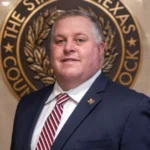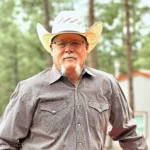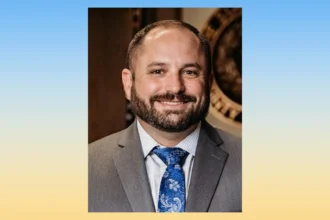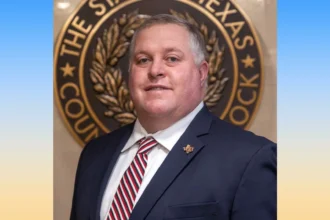



The Slaton businessman and former school trustee argued that Lubbock County needed tighter spending controls, better infrastructure planning and fewer public conflicts among its leaders.
Justin Martin entered the 2026 race for Lubbock County commissioner in Precinct 2 with a deliberately unexciting goal: make county government “boring” again.
For Martin, boring government meant officials quietly performing their duties, maintaining roads, funding public safety and managing tax dollars without the courtroom battles and highly publicized disagreements that had recently surrounded the Lubbock County Commissioners Court.
Martin, a lifelong Slaton resident, competed against Kevin Pounds and M. Trey Newton in the Republican primary. His campaign centered on fiscal restraint, infrastructure and transparency, with an emphasis on reviewing the county budget for possible reductions before asking residents for more money.
It was not Martin’s first campaign for the position. He also sought the Precinct 2 seat in 2006, when he was 25. Nearly two decades later, he returned to the race arguing that his business and public-service experience had better prepared him to oversee a growing county.
According to Martin’s campaign biography, he operated a small business for 15 years and served 12 years on the Slaton Independent School District Board of Trustees. His campaign also cited his experience in property management as helpful in understanding infrastructure, maintenance and long-term financial planning.
When he announced his candidacy in September 2025, Martin identified county roads, infrastructure, public safety and responsible use of tax dollars as his principal concerns. He also promised to listen closely to residents of southeast Lubbock County, according to KCBD’s coverage of his announcement.
Budget was at the center of his campaign
Martin treated the county budget as the issue connecting nearly every other responsibility of a commissioner.
The Commissioners Court adopts the annual budget and property-tax rate, issues bonds, approves contracts, maintains county roads and provides services to rural residents. The official Lubbock County description of the Precinct 2 office also lists responsibility for court buildings, the jail, elections and other county facilities.
Martin supported reducing spending where possible but did not identify every county expenditure as unnecessary. Instead, he argued that commissioners had to demonstrate that the existing budget had been made as lean as reasonably possible before seeking additional revenue.
That distinction emerged during a January candidate forum. Martin said county leaders should first verify that departments were operating efficiently. If major projects still could not be funded within the regular budget, he favored taking proposals directly to voters through bond elections.
Rather than asking voters to approve one exceptionally large package, Martin suggested presenting projects in phases over multiple election cycles. That approach, he argued, would give taxpayers more control over the timing and purpose of county borrowing. His comments were reported in Lubbock Lights’ coverage of the candidate forum.
Martin’s broader campaign platform called for full accountability over county spending, along with repairs and upgrades to roads, utilities and public facilities. His argument was that fiscal conservatism required more than simply voting against spending: officials also needed a transparent plan showing which projects were essential, how much they would cost and when taxpayers would be asked to pay.
“Boring” reflected concerns about courthouse conflict
Martin’s call for boring government came amid unusually visible conflict involving Lubbock County officials.
Commissioners had fought over property-tax rates, employee raises and public-safety spending. A separate dispute erupted after County Judge Curtis Parrish attempted to replace Precinct 2 Commissioner Jason Corley with Mark Meurer, arguing that Corley’s congressional campaign had triggered an automatic resignation.
Corley challenged the replacement in court and was temporarily restored to the seat. Meurer continued the case through the appeals process and later sought relief from the Texas Supreme Court, as described in KCBD’s account of the Precinct 2 legal dispute.
Martin used “boring” as shorthand for a less confrontational governing style. His campaign advocated steady leadership, clearer communication and decisions focused on routine county responsibilities instead of political or personal disputes.
That did not mean avoiding disagreements. A commissioner still must decide which departmental requests to fund, whether to raise taxes, how aggressively to improve rural roads and when to borrow for major facilities. Martin’s position was that those disagreements should be resolved through an orderly, transparent process that residents could understand.
Martin narrowly missed the runoff
The March 3 Republican primary ended without any candidate receiving a majority. Pounds led the three-candidate field with more than 39% of the vote.
The contest for second place was much closer. Newton finished approximately 120 votes ahead of Martin, according to KTTZ’s report on the primary results. That narrow difference eliminated Martin and sent Pounds and Newton to the May 26 runoff.
Pounds ultimately won the nomination with about 60% of the runoff vote and was positioned to become the next Precinct 2 commissioner, as KCBD reported after the election.
Although Martin did not advance, his campaign framed an important question for Lubbock County: whether commissioners can manage growth, repair infrastructure and protect essential services while cutting unnecessary expenses—and do it without making county government a continuing source of public drama.