


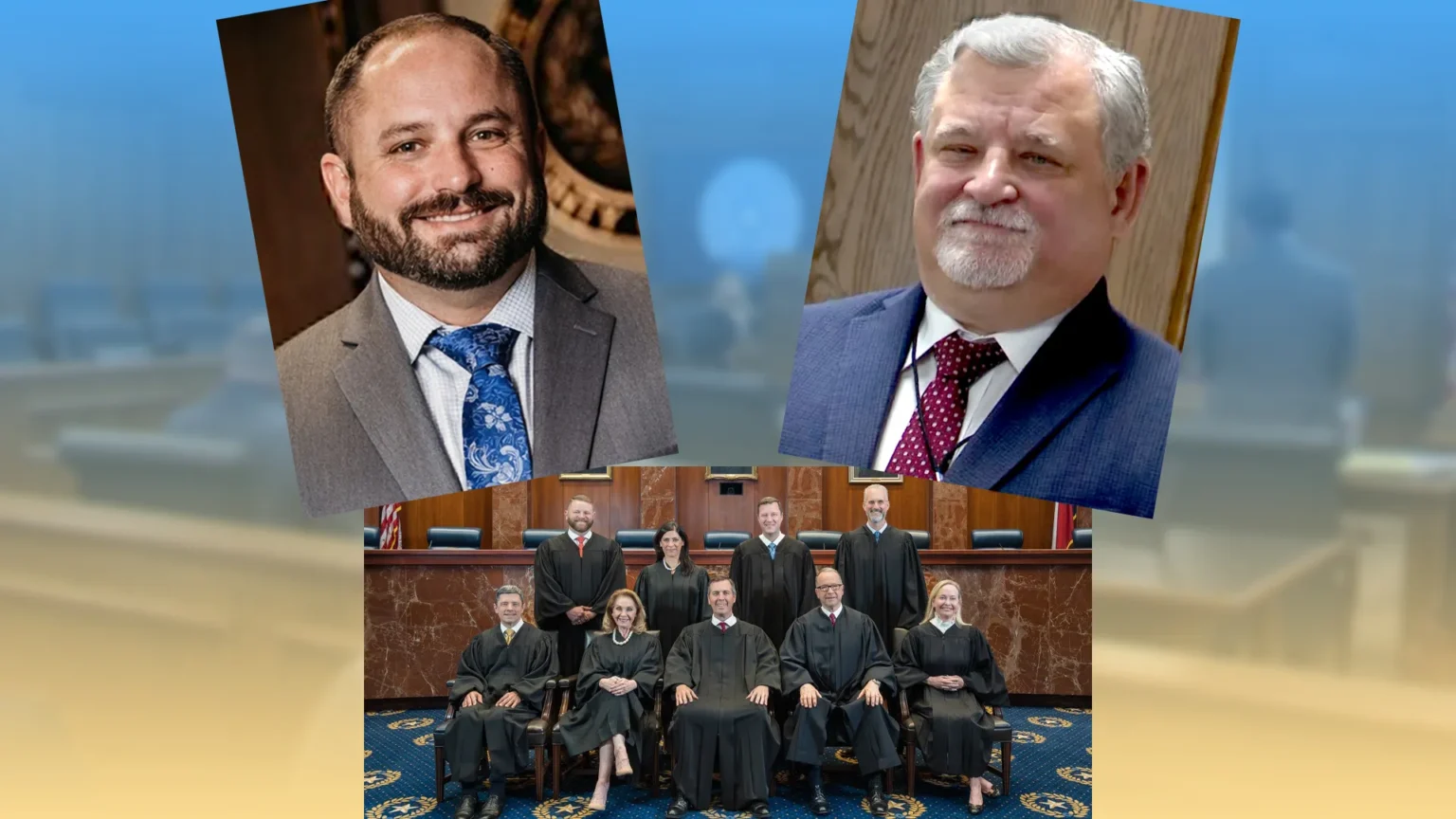
The legal battle over who lawfully holds the Lubbock County Precinct 2 commissioner’s seat remains unresolved, although Texas’ highest civil court has declined to remove Commissioner Jason Corley while the case proceeds.
The dispute began after County Judge Curtis Parrish concluded that Corley had automatically resigned under the Texas Constitution by becoming a candidate for Congress too early. Parrish subsequently appointed Mark Meurer to fill what he considered a vacancy and administered the oath of office to him on Dec. 8, 2025.
Corley challenged that decision in court, setting off proceedings in a Lubbock district court, the Seventh Court of Appeals in Amarillo and the Texas Supreme Court.
A trial initially expected in April 2026 was postponed while the appellate courts considered Meurer’s challenges. The Texas Supreme Court temporarily stopped the trial-court proceedings on Feb. 20, but on May 1 it denied Meurer’s petition for a writ of mandamus and lifted the stay.
That decision left Corley in office, but it did not amount to a final ruling on every issue in the case.
Disagreement over when Corley became a candidate
The controversy centers on Texas’ “resign-to-run” provision. Under Article XVI, Section 65 of the Texas Constitution, certain local officeholders automatically resign if they announce a candidacy or become candidates for another office when more than one year and 30 days remain in their current terms.
Corley’s term as commissioner expires Dec. 31, 2026. That made Dec. 1, 2025, the critical date in determining whether an announcement or other action triggered the constitutional provision.
Corley announced the creation of an exploratory committee for the 19th Congressional District race on Nov. 12. Parrish determined that Corley had effectively become a congressional candidate at that point, while more than one year and 30 days remained in his county term.
Corley argued that an exploratory committee was not the same as an official candidacy. According to court filings, he publicly announced that he was running for Congress on Dec. 2 and filed his ballot application the following day—after the constitutional deadline had passed.
The State of Texas entered the lawsuit on Corley’s side. In its filing, the state argued that Corley had not publicly announced an unconditional candidacy before Dec. 2 and that no vacancy existed when Parrish appointed Meurer.
Meurer and his attorneys disputed that interpretation. They argued that Corley’s public activities and other communications showed he had become a candidate before the deadline. Meurer also challenged whether Corley followed the proper legal procedure when he sued to regain the office.
Visiting judge returned Corley to the seat
After Corley filed his lawsuit, the regularly assigned judge recused himself and visiting Judge Patrick Pirtle took over the case. Pirtle issued a temporary order returning Corley to the Precinct 2 seat while the underlying legal questions were litigated.
That ruling did not conclusively decide whether Corley had triggered the resign-to-run provision. It preserved the pre-dispute arrangement by allowing him to continue serving during the case.
Meurer sought emergency relief from the Seventh Court of Appeals, which declined to immediately overturn the temporary order. He then asked the Texas Supreme Court to intervene, contending that the trial court lacked authority to restore Corley and that procedural errors had occurred.
The Supreme Court’s February stay temporarily prevented the district court case from moving forward. With the stay in place, lawyers for Meurer and the State of Texas agreed that proceeding with the scheduled April trial would be impractical. The trial was therefore delayed while the appellate issues remained under review.
On May 1, however, the Supreme Court denied Meurer’s mandamus petition. The court’s short order did not provide a detailed explanation or decide the broader factual dispute over when Corley became a congressional candidate. As KCBD reported after the ruling, the denial meant the high court would not order Pirtle to withdraw the temporary ruling that returned Corley to office.
Appeals and trial questions remain
As of the latest published case update on May 4, two related proceedings remained before the Seventh Court of Appeals: an appeal involving the temporary order and a separate mandamus action. The district court trial had not been rescheduled at that time, according to Lubbock Lights’ account of the Supreme Court decision.
The litigation also has financial consequences for Lubbock County. Corley submitted legal expenses for reimbursement after hiring private attorneys to contest his attempted removal. Commissioners approved approximately $12,000 in legal bills, although Parrish objected to reimbursing the expenses before the case had reached a final resolution.
The dispute’s practical window is narrowing. Corley’s term ends Dec. 31, and Kevin Pounds won the Republican runoff for the next Precinct 2 term in May, according to KCBD’s election coverage.
Still, a final court ruling could clarify more than who occupies the seat during the remaining months of Corley’s term. The case raises broader questions about what conduct makes an officeholder a candidate under Texas law, whether an exploratory campaign triggers automatic resignation and what procedure must be followed when county officials disagree over whether a vacancy exists.
For now, Corley continues serving as Precinct 2 commissioner, Meurer continues contesting his right to the office, and the ultimate legal questions remain unsettled.