

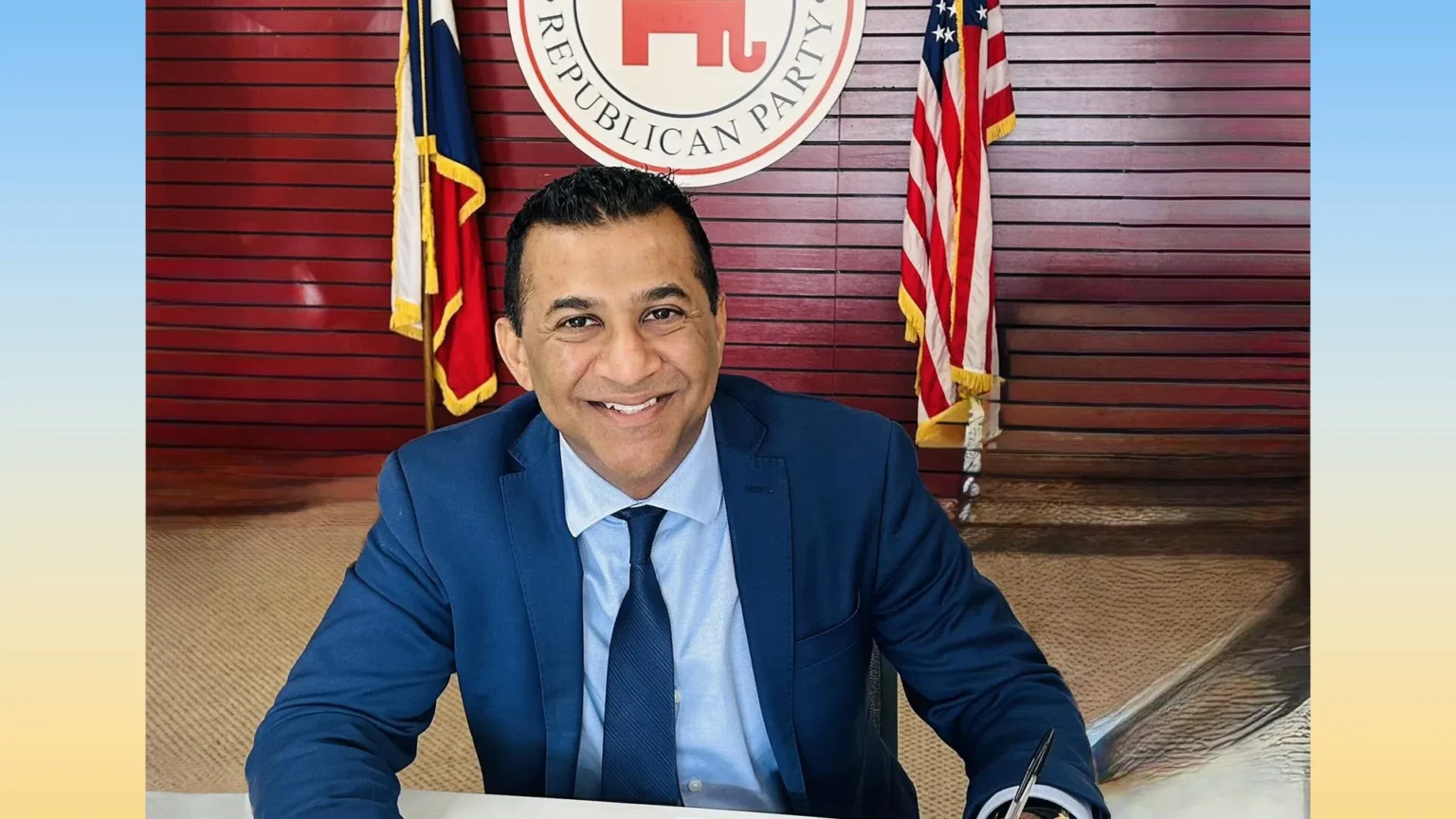
Lubbock healthcare executive Gulrez “Gus” Khan entered the 2026 Republican primary for the U.S. Senate arguing that many of Washington’s problems could be addressed by preventing politicians from remaining in Congress for decades.
Khan proposed limiting members of both the House and Senate to 12 years of service. He said the change would reduce the influence of career politicians and create more opportunities for people with experience outside government to hold federal office.
“We need citizen leaders, not career politicians,” Khan told Lubbock Lights before the March 3 primary.
Khan frequently pointed to incumbent Republican Sen. John Cornyn, who was first elected to the Senate in 2002, as an example of a politician who had remained in Washington too long. He also criticized longtime lawmakers from both parties, contending that extended congressional careers can separate elected officials from the people they represent.
His term-limit proposal, however, would require more than passing an ordinary federal law. Khan’s campaign supported a constitutional amendment establishing a 12-year maximum.
The U.S. Supreme Court ruled in U.S. Term Limits v. Thornton that states cannot impose additional qualifications on congressional candidates beyond those contained in the Constitution. The Constitution Annotated maintained by Congress explains that the decision prevents individual states from setting congressional term limits.
A federal constitutional amendment proposed by Congress would need approval from two-thirds of both the House and Senate, followed by ratification by three-fourths of the states.
From healthcare management to politics
Khan immigrated to the United States from India in 2001 and made his home in Lubbock. He became a co-owner and chief development officer of American Star Home Health & Hospice Care and said he accumulated more than 15 years of healthcare-management experience.
Before entering the Senate race, Khan served as a local Republican precinct chair and ran for mayor of Lubbock in 2022. He sought the Republican nomination for the U.S. House in Texas’ 32nd Congressional District in 2024, even though he continued to live in Lubbock.
Federal candidates for the House must live in the state they seek to represent but do not have to reside within the congressional district. Khan described that campaign as an attempt to help Republicans compete in a Democratic-leaning Dallas-area district. He received 7.4% of the primary vote and did not advance.
Khan later attended the 2024 Republican National Convention as a Texas delegate.
His Senate campaign presented that combination of business, political and healthcare experience as an alternative to candidates who had spent much of their careers in elected office.
Healthcare proposals shaped by West Texas
Healthcare was another major part of Khan’s platform. He said his experience managing primary-care clinics, a hospitalist group, wound-care operations and home-health services gave him insight into the problems affecting rural hospitals, healthcare providers and elderly patients.
His proposals included expanding telehealth, reducing documentation requirements for home-health and hospice organizations, increasing certain Medicare and private-insurance reimbursement rates and establishing faster decisions for urgent insurance authorizations.
Khan also supported greater disclosure of health-insurance denial and appeal rates, reimbursement for palliative care and incentives for locally owned pharmacies. Additional details appeared in his published BallotReady candidate profile.
Beyond healthcare and term limits, Khan campaigned as an “America First” Republican. His platform supported stronger border enforcement, increased domestic energy production, reciprocal tariffs, vocational education, a balanced-budget amendment and a foreign policy based on military strength.
He also called for proposed legislation to be publicly available for at least 72 hours before a congressional vote, arguing that voters should have an opportunity to review major bills before lawmakers act.
A small campaign in a statewide contest
Khan competed in an eight-candidate Republican primary dominated by Cornyn, Texas Attorney General Ken Paxton and U.S. Rep. Wesley Hunt.
His campaign operated on a substantially smaller budget. Khan’s authorized committee reported about $10,600 in receipts and $11,200 in expenditures from July 2025 through March 2026, according to Federal Election Commission records. The receipts included $3,900 in loans from Khan.
Khan received approximately 15,800 votes, or about 1% of the Republican primary total, according to results published by KSAT. He finished sixth and did not advance.
Cornyn and Paxton proceeded to the May 26 runoff after neither secured a majority in March. Paxton subsequently defeated Cornyn to win the Republican nomination and is scheduled to face Democratic nominee James Talarico in November.
Although Khan’s campaign ended in the primary, it gave Lubbock a candidate in one of the state’s most closely watched races. It also provided him with a statewide platform for an argument that has attracted support across several election cycles: Congress should be a temporary place of service, not a permanent career.