


Questions about appellate jurisdiction, the effect of a written trial-court order and Meurer’s status as an officeholder have complicated his challenge. Jason Corley remains commissioner while the underlying dispute continues.
Mark Meurer’s attempt to take control of the Lubbock County Precinct 2 commissioner’s office has encountered a series of procedural and jurisdictional obstacles in Texas courts.
Meurer was sworn into office Dec. 8, 2025, after County Judge Curtis Parrish declared that elected Commissioner Jason Corley had automatically resigned by becoming a candidate for Congress. Corley disputed that conclusion and filed a lawsuit seeking restoration to office.
Eleven days later, visiting District Judge Patrick Pirtle issued a temporary order returning Corley to the seat and directing Meurer to step aside. Meurer challenged that ruling in the Seventh Court of Appeals and later asked the Texas Supreme Court to intervene.
The appeals have not returned Meurer to office. On May 1, the Texas Supreme Court denied his petition for a writ of mandamus and lifted a stay that had temporarily paused the trial-court case. The official Lubbock County website continues to list Corley as the Precinct 2 commissioner.
The high court’s decision did not finally determine whether Corley triggered the Texas Constitution’s resign-to-run provision. It declined to grant Meurer the extraordinary relief he requested from the trial court’s temporary order.
Dispute began with Corley’s congressional plans
Corley’s current term as commissioner runs through Dec. 31, 2026.
The Texas Constitution’s resign-to-run provision says certain officeholders, including county commissioners, automatically resign if they announce candidacy or “in fact become a candidate” for another office while more than one year and 30 days remain in their current term.
Corley announced the formation of a congressional exploratory committee Nov. 12, 2025. Two days later, he sent a private message in which he reportedly said he was running for Congress. He made his public campaign announcement Dec. 2 and applied for a place on the Republican primary ballot Dec. 3.
The timing matters. For Corley, the automatic-resignation cutoff was Dec. 1, according to the state’s court filing. Parrish concluded that Corley had become a candidate before the cutoff because of the exploratory committee and the private message.
Corley argued that he had not made an unconditional public announcement and did not formally become a candidate until after the deadline.
On Dec. 8, Parrish declared the Precinct 2 office vacant, had Corley removed from his county office and administered the oath to Meurer. Corley sued that day.
State intervened on Corley’s side
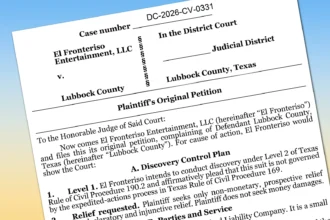
The dispute developed into a quo warranto proceeding—a type of case used to determine whether someone is unlawfully holding a public office.
Potter County Attorney Scott Brumley intervened on behalf of the State of Texas. The state’s petition in the trial court argued that Corley remained the lawful commissioner because neither his exploratory committee nor his other activities triggered an automatic resignation before Dec. 1.
The state contended that, because no vacancy legally existed, Parrish had no authority to appoint Meurer.
Meurer challenged whether Corley could bring the case and whether the state had properly intervened. Pirtle allowed the state’s case to proceed and issued the temporary order restoring Corley on Dec. 19.
That order was not a final judgment following a full trial. It established who would occupy the office while the litigation continued.
Appeals court questions Meurer’s case
Meurer sought emergency relief from the Seventh Court of Appeals in Amarillo. The court declined to suspend Pirtle’s order before the next Commissioners Court meeting, leaving Corley in office.
The Seventh Court later raised several questions that could prevent it from reaching the central resign-to-run dispute.
The first concerns whether Meurer was legally an officeholder. His lawyers argued that state law automatically stayed Pirtle’s order because it removed a government official from office. But the appellate court questioned whether Parrish’s decision to administer the oath was enough to make Meurer a lawful commissioner when the existence of a vacancy was itself disputed.
The second obstacle concerns the difference between Pirtle’s oral ruling during the Dec. 19 hearing and his subsequent written order.
Meurer’s original appellate arguments focused heavily on the oral ruling. The Seventh Court told the parties that a written order ordinarily controls when it differs from an earlier oral pronouncement. The court also indicated that the written order might not contain the same alleged defects challenged in Meurer’s appeal.
A third issue is whether Meurer filed in the correct appellate court.
Because the State of Texas intervened in the case, Brumley argued that jurisdiction belongs to the Fifteenth Court of Appeals in Austin, which was created to handle certain cases involving state agencies or the state government. He contended that the Seventh Court in Amarillo lacked authority to decide the appeal.
The Seventh Court similarly asked the parties to explain why it had jurisdiction over the interlocutory appeal. Those questions were detailed in Lubbock Lights’ March report on the appellate obstacles.
Texas Supreme Court declines to intervene
Meurer separately asked the Texas Supreme Court to order the lower courts to undo Pirtle’s temporary ruling. His lawyers argued that the hearing should have stopped when they filed an appeal and that continuing it violated Meurer’s procedural and due-process rights.
On Feb. 20, the high court partially granted Meurer’s emergency request by pausing further trial-court proceedings. The stay did not put Meurer back in office; Corley continued serving while the Supreme Court reviewed the mandamus petition.
On May 1, the court denied the petition and lifted the stay. The court did not issue a written opinion explaining its reasoning.
The denial left Pirtle’s temporary order intact and Corley in office. It also allowed proceedings in the underlying Lubbock case to resume.
Separate appellate matters concerning the temporary order and the Seventh Court’s authority remained unresolved in the latest publicly reported update. A final trial-court judgment could still determine whether Corley automatically resigned and whether Meurer’s appointment was valid.
For now, however, the practical result is clear: Corley occupies the Precinct 2 seat, while Meurer’s efforts to replace him have not succeeded.