

City leaders say they need firmer construction costs, operating projections and a clearer financing plan before asking voters to approve a hotel-tax increase
Lubbock voters are unlikely to decide the future of a proposed hotel-tax increase for the Lubbock Memorial Civic Center this November, as city officials say too many financial questions remain unresolved.
Mayor Mark McBrayer, City Manager Jarrett Atkinson and members of the City Council discussed the project during a July 15 budget workshop. Although no formal vote was taken, the discussion indicated that city leaders would prefer to postpone the election until 2027 instead of presenting voters with preliminary cost and revenue estimates.
The city’s official agenda for the workshop specified that the Council would discuss the Civic Center and other budget priorities but would take no action.
That distinction is important: the November election has not been formally canceled because the Council had not yet called one. However, McBrayer said he did not believe the city would be prepared to hold the vote this year.
The Council would have to act at its first meeting in August to place the issue on the November ballot, Atkinson said. That gives city staff only a short period to complete a credible construction budget, financing plan and operating forecast.
McBrayer previously favored a November 2026 vote but said having a well-developed proposal—and improving its chances of receiving voter approval—is more important than meeting that schedule.
City does not have a final project price
The principal obstacle is that the Civic Center plan remains at the conceptual stage.
Atkinson said the city is continuing to refine its budget but does not yet have a figure he is comfortable presenting as the project’s definitive cost. Releasing an early estimate could cause the public to treat it as a fixed price even though the design and market conditions could still change.
He compared the process to presenting a street-bond proposal. Before asking residents to approve road debt, the city generally identifies the precise streets, number of lanes, drainage improvements and estimated cost of each segment.
Officials do not yet have that level of detail for the Civic Center.
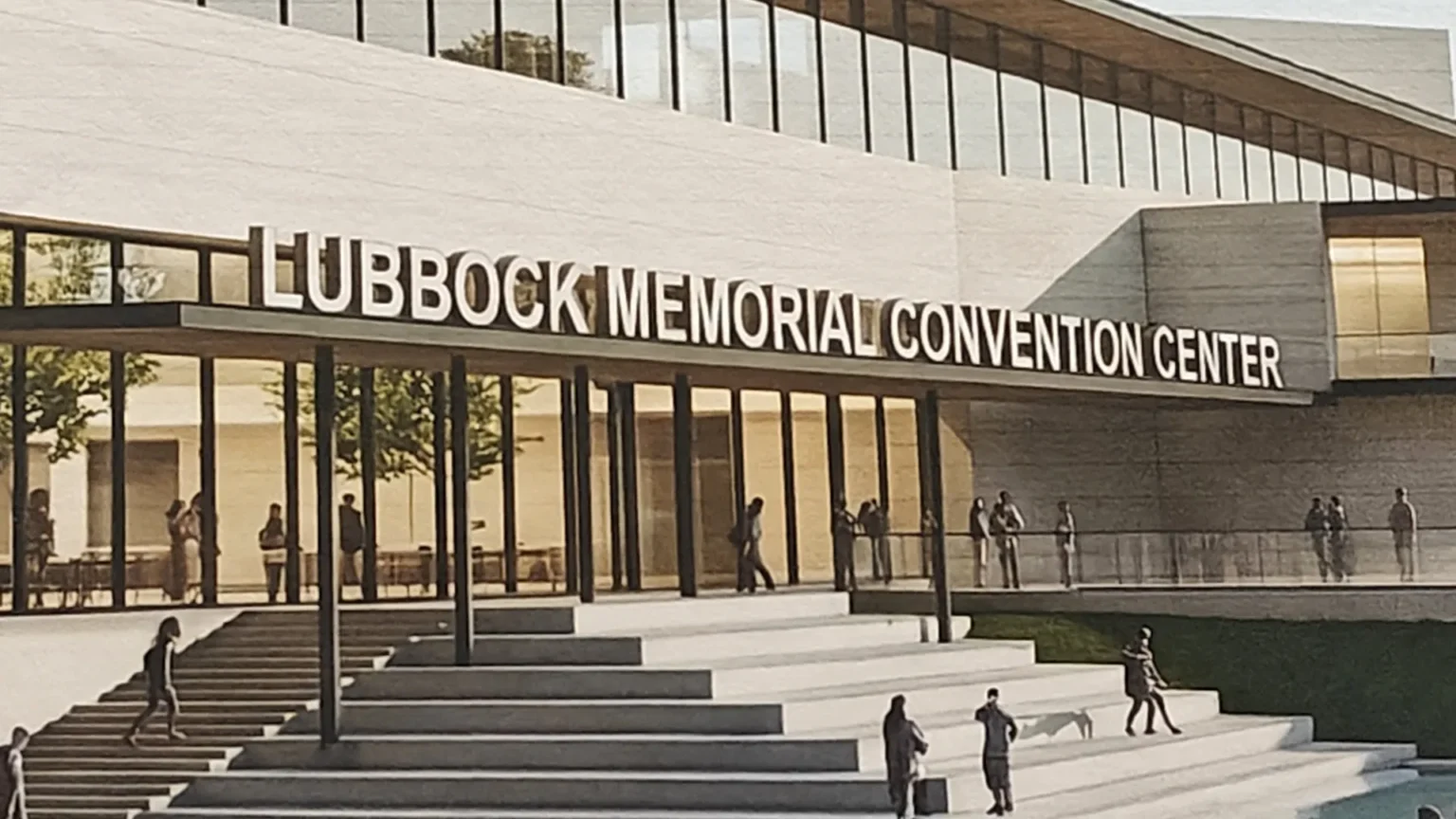
The Council approved an initial design in April after the city held two public meetings and gathered feedback on competing concepts. The selected plan includes a 60,000-square-foot expansion, changes to existing event areas and significant additional parking. KCBD reported that the conceptual design included approximately 2,400 new parking spaces.
The expansion would create a new 60,000-square-foot event space. An existing portion of the building would be converted into another approximately 40,000-square-foot event area. Plans would also reorient the facility’s primary public entrance toward the south, where city leaders hope additional commercial development and a convention hotel could follow.
The current Lubbock Memorial Civic Center is a roughly 300,000-square-foot facility at 1501 Mac Davis Lane. It hosts conventions, trade shows, meetings, banquets, cultural programs and sporting and entertainment events.
The city hired architecture and design firm TVS under a $200,000 contract to develop conceptual plans and project-cost estimates. That contract was approved in February as an early planning step, according to KCBD’s coverage of the agreement.
How the project could be financed
Officials have identified four possible funding sources:
- Revenue from a new project financing zone
- A portion of Lubbock’s existing hotel occupancy tax
- A voter-approved venue tax that would increase the tax charged on hotel stays
- Private contributions
Atkinson emphasized that the plan is not expected to rely on local property taxes. That does not mean the project would have no public-tax component: the proposed venue tax would be collected from hotel customers, while other hotel-related revenue would also support the project.
The amount voters would be asked to approve has not been finalized.
A major part of the financing plan became possible when the Texas Legislature passed House Bill 2313 in 2025. The law authorized Lubbock to establish a project financing zone around a qualifying project such as the Civic Center.
Under the system, Lubbock could retain growth in certain state hotel-related revenues generated within a three-mile radius of the project instead of sending all of that incremental revenue to Austin. The zone can capture increases in state hotel, sales and mixed-beverage taxes associated with hotels in the designated area.
The Texas Legislature’s analysis of House Bill 2313 confirms that the legislation expanded project-financing-zone authority to Lubbock and other qualifying cities.
The Texas Comptroller has estimated that Lubbock’s zone could generate approximately $121.7 million through 2055, according to figures presented to the Council. That estimate represents projected revenue over nearly three decades, not cash immediately available for construction. The city could potentially issue debt backed by the future revenue.
Atkinson recommended formally creating the project financing zone in August 2026. Doing so would begin a five-year period during which the city must initiate the qualifying project.
The state’s fiscal analysis of the legislation explains that project zones may receive incremental hotel-associated state revenue for as long as 30 years.
Council wants evidence of public benefit
Councilman Tim Collins suggested that the city prepare a community-benefit analysis explaining how the project could affect jobs, tourism, hotel stays, downtown businesses and municipal revenue.
He also called for a pro forma showing the Civic Center’s expected income and operating expenses after the expansion. Such a forecast could help voters judge whether the renovated facility would generate enough activity to justify its construction and long-term maintenance costs.
The objective is not simply to show what the building would look like. City leaders also want to demonstrate how it would operate, what economic benefits it could reasonably produce and how each funding source would be used.
The need for additional financial work was first detailed in Lubbock Lights’ report on the likely election delay.
Postponing the election would not necessarily delay every part of the project. The city can continue refining the design, establishing the financing zone, developing operating projections and seeking private support before approaching voters.
Officials offered preliminary construction timelines ranging from early 2028 to early 2029. Those dates remain estimates and will depend on voter approval, financing, final design and contracting.
For now, the clearest change is in the election strategy: city leaders still want to pursue the Civic Center expansion, but they appear prepared to wait until they can tell voters exactly what they would receive and how it would be paid for.