

Candidates for county judge and two Commissioners Court seats outlined different approaches to salaries, infrastructure spending and property taxes.
Candidates seeking three Lubbock County offices faced pointed questions about employee compensation, elected officials’ raises and the county’s ability to maintain aging facilities without collecting additional property-tax revenue.
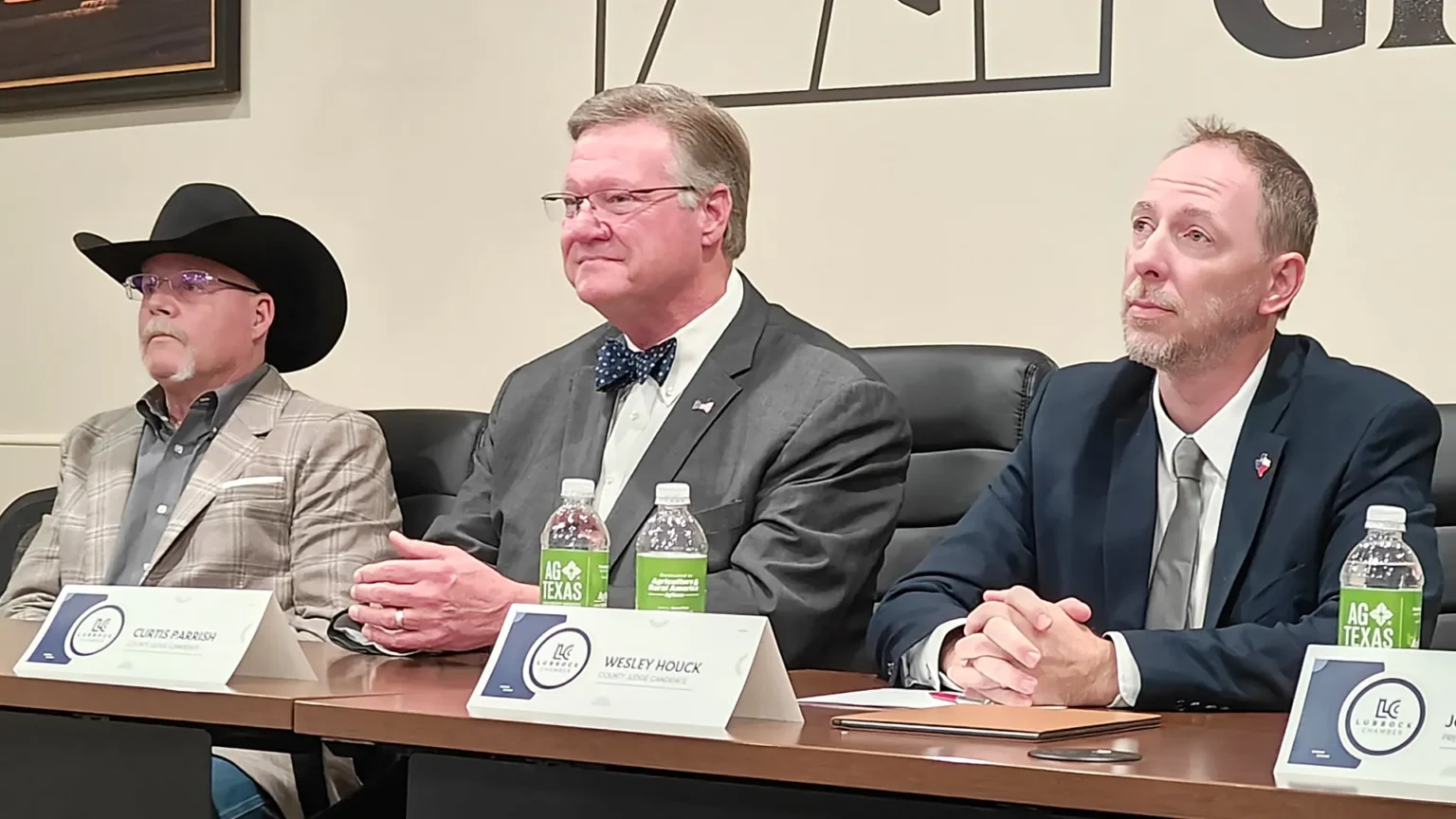
The discussion came during a January 2026 candidate forum hosted by the Lubbock Chamber of Commerce and Plains Cotton Growers. Kody Bessent, chief executive officer of Plains Cotton Growers, moderated the event.
The participants included county judge candidates Curtis Parrish, the incumbent, and Wesley Houck; Precinct 2 commissioner candidates Justin Martin and Kevin Pounds; and Precinct 4 candidates Jordan Rackler, Chad Seay and C.J. Peterson. Precinct 2 candidate Trey Newton did not attend.
Jason Corley, the incumbent Precinct 2 commissioner, did not seek another term in that office because he was running for Congress.
Candidates questioned about elected officials’ raises
One audience question focused on the county’s FY2026 budget, which included a 2% cost-of-living adjustment for elected officials while rank-and-file employees did not receive the broader raises that had been discussed during budget deliberations. The county’s official budget presentation noted that seven elected officials declined their increases.
Seay, who represented Precinct 4 on the Commissioners Court from 2018 through 2022, said he never voted to increase elected officials’ salaries. When raises were approved during his time in office, he said, he returned the additional money.
Seay also noted that commissioners receive salaries exceeding $90,000, arguing that candidates know the compensation attached to the position before seeking office.
Rackler defended his vote for the elected-official increases but said he declined to accept his own raise. He said he voted with the understanding that county employees would receive a 3% cost-of-living adjustment and potentially another 2% based on merit.
When the employee increases were removed, the process for setting elected officials’ compensation had already advanced too far to be easily reversed, Rackler said. He added that some elected positions—including sheriff, constable and justice of the peace—must offer competitive salaries to attract qualified candidates.
Peterson did not directly address whether commissioners should have received raises. Instead, he emphasized the value of the county workforce. Drawing on his experience operating a business with about 40 employees, Peterson said government cannot provide dependable services if it fails to recruit and retain capable workers.
Parrish said he had promised not to accept a salary increase during his time as county judge and had kept that commitment. He said he would support cost-of-living increases for elected officials only when the same adjustment was provided to county employees.
Houck, who cited his experience on the Wolfforth City Council, said employee retention should be treated as a financial issue as well as a personnel matter. Losing experienced workers can leave taxpayers paying recruitment and training costs that exceed the expense of maintaining competitive compensation, he said.
Houck said he had not based his campaign on the county judge’s salary and would not seek a raise if elected.
Martin similarly said he knew the commissioner’s salary before entering the race. He said he would not accept an increase and suggested he might return a portion of the salary to demonstrate that compensation was not his reason for running.
Pounds did not specifically address elected officials’ raises, but he said the county must take care of its employees and ensure they are compensated fairly.
Debate shifts to taxes and infrastructure
The second major audience question asked how the county could repair or replace aging facilities while repeatedly adopting the no-new-revenue property-tax rate.
Under Texas law, the no-new-revenue rate is designed to generate approximately the same property-tax revenue from properties taxed in both years, excluding revenue attributable to new construction. It is different from the voter-approval rate, which generally allows additional operating revenue before an election is required.
The question carries particular weight because Lubbock County faces expensive facility needs, including renovations to the county offices at 916 Main St. and work involving the adjoining parking garage.
Seay said the county should aggressively pursue state and federal grants. However, he warned against draining reserves to complete construction projects, noting that the county needs readily available money to respond to tornadoes and other emergencies.
Rackler defended using the no-new-revenue rate. He said he had examined the county budget and continued to see expenses that could be reduced before officials asked property owners for more money.
Peterson said rising construction, supply and operating costs have made the county’s position more difficult since the COVID-19 pandemic. Officials should look for reductions first, he said, but there could come a point when voters must decide whether they are willing to pay more for major infrastructure.
Parrish was more critical of adopting the lower rate. He said the decision resulted in a $1.4 million reduction connected to the Sheriff’s Office and about $250,000 less for county fire departments. Other commissioners previously disputed the characterization of the sheriff’s reduction, saying it involved money budgeted—but not used—to house inmates outside Lubbock County.
The disagreement reflects a long-running division on the Commissioners Court over whether holding down the tax rate protects residents or leaves essential county operations without enough money.
Houck called higher taxes a last resort and said officials should exhaust other possibilities first. Pounds offered a similar assessment, saying taxpayers would eventually have to cover necessary expenses if officials could demonstrate that the budget had already been reduced as much as reasonably possible.
Martin said the county should first prove that its existing budget is lean and transparent. For major projects, he suggested creating a long-term capital plan and presenting phased bond proposals to voters, potentially at two-year intervals.
The forum exposed a central choice for Lubbock County: whether to continue limiting property-tax collections as operating and construction costs rise, or ask voters to approve additional revenue for employees, public safety and deteriorating facilities.