


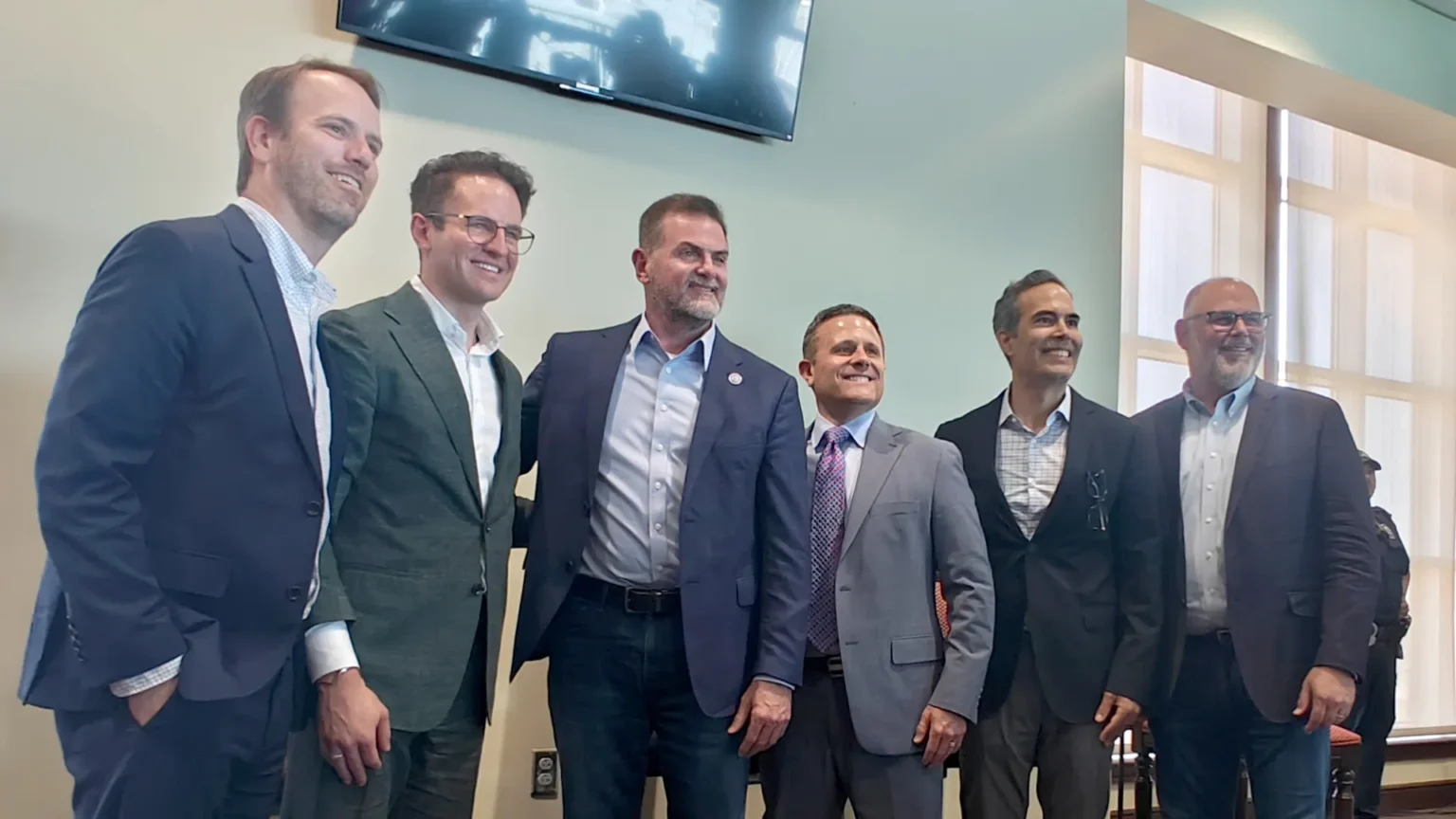
Industry and civic leaders argued that data centers are important to America’s technological competitiveness, while residents questioned their effects on local resources, utility bills and public oversight.
LUBBOCK, Texas — The debate over artificial-intelligence data centers in West Texas is no longer limited to jobs and economic development. It now includes questions about water consumption, electrical-grid capacity, national security and how much influence residents should have over projects that could reshape their communities.
Those issues dominated a Lubbock Chamber of Commerce forum held at Texas Tech University’s Jones AT&T Stadium.
Panelists included Texas Tech University System Chancellor Brandon Creighton; Chris Matos, a strategic negotiator for Google; former Texas Land Commissioner George P. Bush; and John Osborne, president and CEO of the Lubbock Economic Development Alliance. Texas Tribune Editor-in-Chief Matthew Watkins moderated the discussion.
Creighton said public accountability must be central to decisions involving data centers, particularly when projects could place substantial demands on natural resources. Companies and government officials, he said, must provide clear answers about a development’s risks and benefits.
That concern has already affected projects around Lubbock. A proposed data center in northeast Lubbock was placed on hold after residents raised objections during the city’s planning process. Meanwhile, construction has started on Project Caprock, a 313-acre development near Abernathy, and another data-center project is advancing in Dickens County.
Water remains a defining concern
Data centers generate large amounts of heat, requiring cooling systems that may use water, air or a combination of technologies.
That makes water consumption especially sensitive in West Texas, where communities depend on limited groundwater and surface-water supplies. Protesters outside the forum argued that residents should receive more detailed information before local officials approve any large development.
Steven Sanders, a former Lubbock mayoral candidate, advocated an 18-month moratorium on new data-center proposals in the city. He said a routine vote by the City Council or Planning and Zoning Commission was not sufficient for decisions that could affect water supplies, electricity costs and household finances.
Panelists said water demand can vary substantially depending on a facility’s design.
Osborne said an open-loop cooling system, in which water is discharged after absorbing heat, would not be suitable for Lubbock. Closed-loop systems, by comparison, recirculate cooling fluid instead of continually replacing it. Google describes its own approach as balancing water availability, carbon-free electricity and alternatives to freshwater when selecting cooling systems.
Creighton suggested brackish groundwater could also become part of the solution. Unlike drinking water, brackish groundwater contains enough dissolved minerals to require treatment before most municipal uses.
The Texas Water Development Board estimates that more than 3.2 billion acre-feet of brackish groundwater exists within 12 of Texas’ major and minor aquifers. Using it, however, would require infrastructure, treatment and careful monitoring to prevent harm to surrounding freshwater resources.
Creighton said developers could potentially use brackish water in an outer cooling loop or build on-site desalination systems, reducing competition with municipal drinking-water supplies.
Rapid growth raises questions about electricity
The forum also examined whether the electrical grid can keep pace with the growth of AI infrastructure.
Data centers are among the most energy-intensive types of commercial buildings. A U.S. Department of Energy-supported study estimated that they consumed about 4.4% of U.S. electricity in 2023. Their share could increase to between 6.7% and 12% by 2028.
The pressure is particularly significant in Texas. As of March 2026, ERCOT was tracking approximately 410 gigawatts of proposed large electrical loads, about 87% of which were connected to data-center proposals. Not every project in the interconnection queue will be built, but the total illustrates the scale of developer interest.
Osborne acknowledged that newer facilities use far more electricity than the data centers he encountered earlier in his economic-development career. He said LEDA would not support a project merely because a developer wanted to build in Lubbock.
According to Osborne, the organization has previously declined to pursue more than a dozen projects—representing a combined estimated investment of roughly $25 billion and as many as 10,000 potential jobs—because their water requirements were considered excessive.
He also said LEDA generally prefers that major projects locate within Lubbock’s city limits, where municipal rules provide more opportunities for oversight than in unincorporated areas.
Panel connects data centers to national security
Panelists argued that data centers are not solely local economic-development projects. They are also part of the global competition to develop and control artificial intelligence.
Creighton claimed the United States was only “27 days ahead of China” in AI development while remaining decades behind China in nuclear-power construction. The precise 27-day comparison was presented as his assessment at the forum, not as an independently established measurement.
Bush said American AI systems should reflect democratic values instead of depending on technology controlled by an authoritarian government. He cited Chinese cyber operations targeting American telecommunications systems as evidence of the security risks.
The FBI and Cybersecurity and Infrastructure Security Agency have confirmed that People’s Republic of China-affiliated actors compromised multiple telecommunications networks, obtaining customer call records and some private communications.
Osborne said locating computing infrastructure in the United States reduces the danger that another country could control or interrupt access to critical systems.
Residents seek enforceable protections
Speakers discussed possible reporting requirements for water and electricity use, additional regulatory authority for counties and community-benefit agreements negotiated before developers receive tax incentives.
Matos acknowledged that data-center companies have not always communicated effectively with communities. He said direct meetings and question-and-answer sessions were more useful than expecting residents to sort through competing claims online.
He also said Google estimates that each direct company position supports nine additional jobs in the surrounding economy. That figure represents Google’s economic-impact estimate; the number of permanent jobs created by an individual data center can vary widely by its size and operating model.
The local discussion continued after the Chamber forum. The City of Lubbock held an official public-input meeting on July 7, publishing background information and proposed development standards for large-scale facilities. The meeting was designed to collect public comments, and its agenda specified that the City Council would take no formal action that evening.
The central question for Lubbock remains unresolved: whether the economic and national-security benefits of new computing infrastructure can be secured without transferring unacceptable water, power and financial risks to the community.