

The lawsuit does not challenge every part of the proposed reliability project. It asks a court to decide whether LP&L may own the 345-kilovolt facilities needed for a fourth connection to ERCOT.
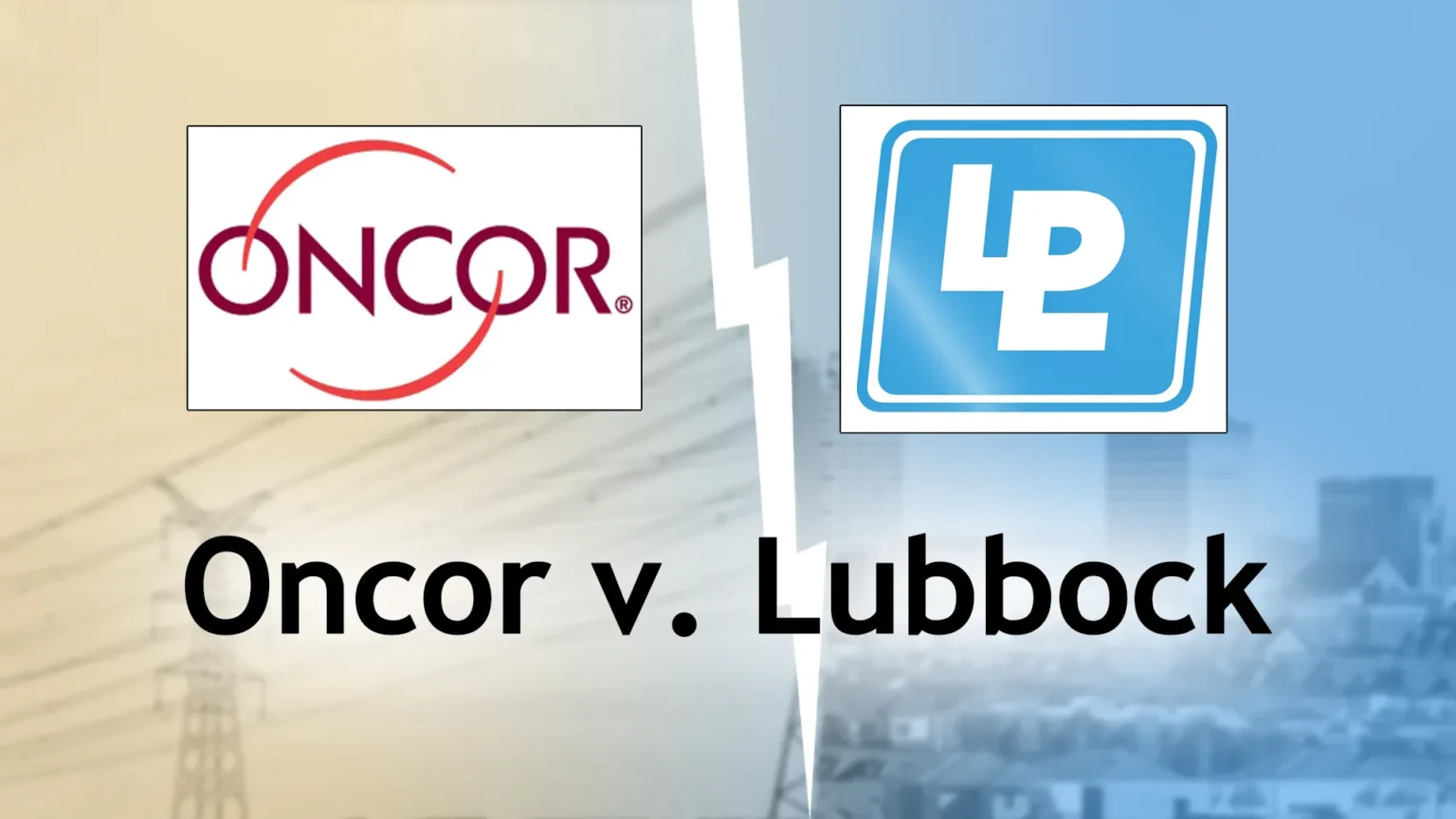
Oncor Electric Delivery Company has sued the City of Lubbock and Lubbock Power & Light over who would own a major switching station included in the proposed West Loop transmission project.
Oncor filed the declaratory-judgment lawsuit Jan. 12, 2026, in the 98th District Court in Travis County. The company wants the court to interpret an earlier agreement governing future transmission development around Lubbock.
The disputed facility would become part of a fourth major connection between Lubbock’s local transmission network and the Electric Reliability Council of Texas, which operates most of the state’s power grid.
The case is not primarily about monetary damages. Oncor is seeking a ruling on ownership and contractual rights, along with its legal fees. LP&L’s fiscal 2025 audited financial report similarly describes the case as a request for a court to determine how ownership of future transmission development should be allocated between the two utilities.
Dispute focuses on Alcove station
The West Loop proposal includes new and rebuilt transmission lines operating at 345, 115 and 69 kilovolts. At the center of the lawsuit is the proposed Alcove station, which would connect the higher-voltage ERCOT transmission system with LP&L’s lower-voltage network.
Electricity carried over a 345-kilovolt transmission line cannot simply enter the portions of LP&L’s system that operate at 115 or 69 kilovolts. Equipment at the new station would reduce the voltage so the electricity could be delivered through Lubbock’s local network.
Oncor does not contend that LP&L is prohibited from constructing future 115-kilovolt facilities to serve customers. Instead, the company argues that the earlier agreement gives LP&L development rights for certain transmission lines—but not ownership rights over a 345-kilovolt station.
LP&L has interpreted the agreement more broadly, according to Oncor’s allegations. The city utility contends that its future-development rights extend to both transmission lines and associated stations.
The contract itself was not included in the publicly available version of the lawsuit. Portions quoting the agreement were redacted as confidential, making it difficult to evaluate the competing interpretations independently.
The case is identified as Oncor Electric Delivery Company LLC v. City of Lubbock and Lubbock Power & Light, Cause No. D-1-GN-26-000237.
Agreement originated with Sharyland
The ownership dispute dates to Lubbock’s multiyear transition from the Southwest Power Pool to ERCOT.
LP&L originally worked with Sharyland Utilities to construct the transmission facilities needed for that transition. Oncor subsequently acquired Sharyland’s interests and assumed rights and obligations under its agreement with LP&L.
Oncor and LP&L jointly participated in several proceedings before the Public Utility Commission of Texas. These included PUC Docket 48668, involving Sharyland and LP&L, and Docket 48909, involving Oncor and the city.
The PUC approved LP&L’s requested ERCOT transition in March 2018. Approximately 70% of the utility’s load moved into ERCOT in May 2021, followed by the remaining customers in December 2023.
For the first phase, Oncor constructed switching stations and new 345- and 115-kilovolt lines connecting Lubbock to ERCOT from the north, south and east, according to ERCOT’s account of the 2021 transition.
The West Loop would add a connection on the city’s western side. Oncor maintains that its inherited contract gives it the initial right to decide whether to develop new 345-kilovolt facilities. LP&L’s rights would arise only afterward and would apply to qualifying transmission lines rather than stations, the lawsuit argues.
LP&L calls project important for reliability
LP&L Chief Public Affairs Officer Matt Rose declined to discuss the city’s legal position when Lubbock Lights first reported the lawsuit. He said, however, that the proposed connection was important to the future reliability and resilience of Lubbock’s electrical network.
LP&L presented the West Loop proposal to ERCOT’s Regional Planning Group on Jan. 16, four days after the lawsuit was filed.
The utility’s official ERCOT presentation identifies the proposal as a Tier 1 transmission project intended to address thermal overloads, low-voltage conditions, stability problems and congestion.
According to LP&L, interruptions on external 345-kilovolt lines can force additional electricity through the city’s 115- and 69-kilovolt systems. The resulting stress could produce hundreds of potential thermal and voltage violations under some transmission-outage scenarios.
The complete proposal includes:
- Approximately 32 miles of double-circuit 345-kilovolt lines.
- A new 345-to-115-kilovolt station.
- About 34 miles of new or upgraded 115- and 69-kilovolt lines.
- New capacitors and supporting equipment at existing stations.
LP&L’s city capital records cited in the original report listed approximately $51.4 million in West Loop expenditures during one year and another $16 million the following year. The broader plan submitted to ERCOT carries a substantially higher estimated cost of $309 million, reflecting the full group of new and upgraded lines, stations and related equipment described in the regional project.
ERCOT review and lawsuit are separate hurdles
The lawsuit does not mean the entire West Loop project has been approved or that construction is imminent. ERCOT began an independent technical review after LP&L’s January presentation, and the proposed route remained subject to significant changes.
LP&L’s presentation listed summer 2030 as the anticipated in-service date.
Even if ERCOT determines that the project is needed, the court dispute could affect which utility develops, owns or controls the 345-kilovolt station. Depending on the ruling or a negotiated settlement, the project could proceed under LP&L, Oncor or some division of responsibilities between them.
The central legal question is therefore narrower than whether West Lubbock needs additional transmission capacity: it is whether the agreement inherited by Oncor permits LP&L to own the high-voltage station required to create that additional connection.