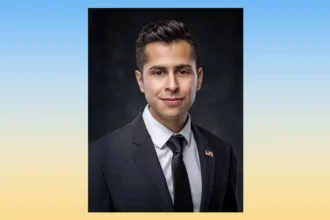



The Wolfforth council member cited his move from Oregon, business experience and concerns about discord in county government as reasons for challenging incumbent Curtis Parrish.
Wesley “Wes” Houck entered the 2026 race for Lubbock County judge with an unusual political résumé: a longtime Oregon resident who moved his family to West Texas, joined the Wolfforth City Council and, less than two years later, challenged an established countywide incumbent.
Houck, who was born in East Texas, spent most of his childhood and adult life in Oregon. His parents divorced when he was young, and his mother returned to the Pacific Northwest to be closer to family. He grew up near the Oregon coast, where surfing, snowboarding and mountain biking were part of his life.
Years later, Houck said Oregon’s changing political climate contributed to his decision to leave. He pointed particularly to the passage of Measure 110, which Oregon voters approved in 2020. The measure decriminalized possession of small quantities of controlled substances while directing cannabis-tax revenue toward treatment and recovery services.
Houck associated the policy with the visible drug use and homelessness he witnessed, although those problems had multiple causes and the effects of Measure 110 remained the subject of political and academic debate. Oregon subsequently changed course. In 2024, lawmakers passed House Bill 4002, which restored misdemeanor penalties for possession of small amounts of certain drugs while creating options to divert defendants into treatment.
Looking for a different place to raise their four sons, Houck and his wife researched Texas communities online. They contacted people in the Lubbock area, made a visit and ultimately moved to Wolfforth in 2022. The family adopted a phrase to describe the decision: “We chose Lubbock.”
Houck presented that move as an important part of his campaign story. Although he had only lived in Lubbock County for several years, he argued that choosing the community gave him a strong interest in its future.
His professional background was primarily in construction. Houck said he spent nearly 25 years working with his brother in homebuilding, including custom and speculative residential projects. He also reported experience in commercial lending and finance and later worked part time for Tesla after moving to the Lubbock area.
Houck said he studied at Multnomah Bible College, which later became Multnomah University, and earned undergraduate degrees in biblical studies and theology, along with coursework in business, education and psychology. He attended seminary but did not complete a graduate degree.
His first elected position came in Wolfforth. Houck won a seat on the City Council and was sworn in during May 2024. He described the experience as an education in municipal budgeting, infrastructure, regulation and cooperation among elected officials.
That experience also shaped how he evaluated Lubbock County government. After attending Commissioners Court meetings, Houck said he saw more division and less agreement about long-term objectives than he had encountered in Wolfforth. In a candidate questionnaire published by Lubbock Lights, he gave the court a C-minus, arguing that its decisions appeared reactive and that disagreements had delayed progress.
Houck made improving relationships among the county judge and four commissioners the first pillar of his campaign. He proposed regular individual meetings with each commissioner to identify precinct needs and address disputes before they reached public meetings.
His second priority was communication. Houck called for earlier notice about major decisions, digital updates for residents and progress reports on expensive county projects.
The third was long-range planning. In a KCBD candidate profile, Houck advocated multiyear plans for roads, public facilities, law enforcement and other services. He argued that annual budgeting alone was inadequate for a county expected to continue growing rapidly.
Infrastructure figured prominently in that agenda. Houck said the county should identify needs across all four precincts, divide large undertakings into manageable phases and seek grants or other revenue before turning to higher property taxes.
Incumbent County Judge Curtis Parrish disputed the suggestion that county leaders lacked a growth strategy. During the campaign, Parrish cited work involving roads, courts, law enforcement facilities and a new medical examiner’s office. In a comparison of the candidates’ positions, both men identified infrastructure, prudent spending and public trust as major concerns, but they differed sharply over the effectiveness of existing leadership.
The office also carries duties beyond managing Commissioners Court. The county judge presides over the court, while commissioners adopt the budget, set the tax rate, maintain county facilities and roads, and approve contracts. According to Lubbock County’s description of the office, the judge also conducts mental-health proceedings, serves on several governmental boards and performs emergency-management and administrative responsibilities.
Houck maintained that his business experience and work in Wolfforth prepared him for both the organizational and public-facing demands of the job. His central argument was that Lubbock County did not lack capable officials—it lacked leadership that could unite them around a common plan.