


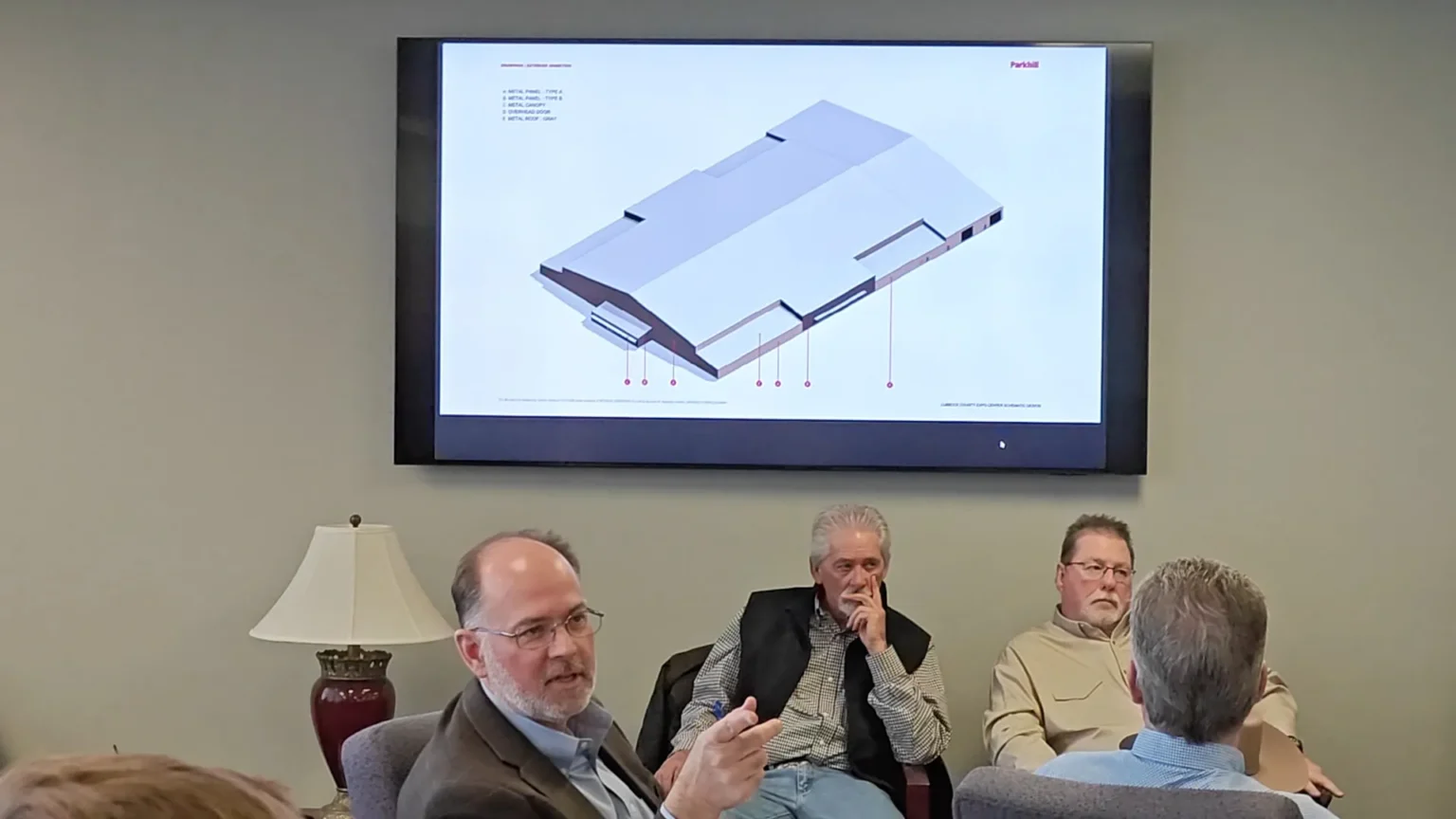
The county’s oversight board required the private Expo Center organization to secure donations or financing before the county issues approximately $32 million in revenue bonds.
LUBBOCK, Texas — Plans for the long-delayed Lubbock County Expo Center have moved closer to financing and construction, but county officials have not offered an unconditional commitment to borrow the money needed for the project.
The Lubbock County Expo Center Local Government Corporation, or LGC, approved a resolution in March establishing several requirements that must be satisfied before the county issues long-term revenue bonds.
The most important condition requires Lubbock County Expo Center Inc., the private nonprofit participating in the project, to demonstrate that it has secured its share of the construction money. That funding can consist of collected donations, binding pledges or a bank loan capable of temporarily covering uncollected contributions.
The nonprofit’s private debt must remain separate from the county’s bond obligation, according to the original Lubbock Lights report and proposed resolution.
The arrangement is intended to prevent the county from issuing bonds only to discover that the private side cannot provide enough money to complete the facility.
How the $67 million plan would be financed
The revised Expo Center was estimated in March to cost approximately $67 million. The proposed funding structure included:
- Approximately $10 million in hotel-occupancy and short-term vehicle-rental taxes already collected for the project.
- Roughly $32 million in county-issued revenue bonds, also repaid from those designated venue taxes.
- Approximately $25 million from private donations, sponsorships or financing arranged by Lubbock County Expo Center Inc.
The project is planned for an approximately 80-acre site near North Loop 289 and North University Avenue.
County officials have said the bonds would be repaid from hotel and vehicle-rental taxes rather than property or general sales-tax revenue. Lubbock County voters authorized the venue-tax funding mechanism in 2018.
The revised plan replaced an earlier design estimated to cost approximately $97 million. More than $7 million had already been used for engineering, architectural work and infrastructure at the site, including roads and utility access. Expo Center supporters said that work retained value, while critics questioned the amount spent without construction beginning.
The county approved another $375,000 for Parkhill to prepare a smaller and more affordable design. The new proposal drew heavily from an arena model used in Abilene, according to KCBD’s January project report.
Conditions attached to county participation
In addition to the private-funding requirement, the LGC resolution called for several financial and operational protections.
The county would retain approximately $5 million as a reserve for unforeseen project or operating problems. Remaining hotel and vehicle-rental tax collections could be used to address operating deficits after the facility opens.
Lubbock County would continue owning the property and Expo Center, but it would lease the facility to the private nonprofit. Lubbock County Expo Center Inc. would oversee operations, including selecting a professional operator subject to the applicable agreements.
The nonprofit also agreed to pay Parkhill’s architectural and design expenses. If the county ultimately does not issue the proposed bonds, designated venue-tax revenue could be used to ensure Parkhill is paid for authorized work.
Another condition requires the Commissioners Court to be satisfied that the nonprofit has raised, or can reliably obtain, enough money to cover development and construction costs exceeding the county’s contribution.
Those provisions made the March action an approval of a financing framework—not authorization to begin construction or immediately sell bonds.
County judge sought additional safeguards
County Judge Curtis Parrish has repeatedly said that he supports constructing an Expo Center but objects to aspects of the existing public-private arrangement.
Parrish questioned the accounting for previous expenditures and argued that the county needed stronger deadlines, more financial documentation and greater control before committing additional public resources.
When commissioners reviewed the revised project on March 23, Parrish proposed requiring the nonprofit to secure its private financing by June 22. He also sought to restore a previously discussed $10 million operating reserve instead of the reduced $5 million reserve.
Neither proposal received the support necessary to be added. Commissioners proceeded with the updated plans, including Parkhill’s design and Lee Lewis Construction’s role as construction manager, as KCBD reported after the March meeting.
County Auditor Kathy Williams also raised concerns about overdue financial audits from the nonprofit. However, she said communication had improved and that her office had begun receiving information it had previously requested.
Long-term operating lease approved
The project took another step forward June 22 when commissioners approved a long-term lease with Lubbock County Expo Center Inc. on a 3-2 vote.
Under the agreement, the nonprofit would pay the county $1 annually and receive a 27-year lease, including an anticipated two-year construction period and 25 years of operation. The agreement also provides options for two additional 25-year renewals.
The county retains ownership, inspection rights, representation on the nonprofit’s board and authority to approve the eventual facility operator. The nonprofit must provide annual financial reports and assume responsibility for maintenance, insurance, utilities and liabilities connected with operating the venue.
Parrish and Commissioner Michael Dalby voted against the lease, saying its termination and control provisions did not adequately protect the county. Commissioners Jason Corley, Jordan Rackler and Cary Shaw supported it.
A detailed examination of the lease by Lubbock Lights found that the nonprofit would have broad operational authority, including control of event revenue and naming-rights opportunities, while the county could declare a default for abandonment, certain financial failures or violations of maintenance and reporting obligations.
Bonds and construction still pending
Approving the lease did not constitute a bond sale or construction groundbreaking.
The latest publicly reported timetable called for Lubbock County to consider issuing approximately $32 million in revenue bonds before the end of 2026, provided that the private financing, final contracts and other conditions remain on track. A June project update described the proposed facility as having 5,500 fixed seats and capacity for about 7,000 people when floor seating is used.
The venue is intended for rodeos, livestock events, concerts, youth competitions and community gatherings. Supporters argue that it would restore event capacity lost when the Lubbock Municipal Coliseum was demolished in 2019.
For now, however, the Expo Center remains a planned public-private project whose construction depends on the nonprofit securing its share of the money and the Commissioners Court granting final approval for the county’s bonds.