


Nearly 500 people ultimately attended the city’s large-scale forum, where most speakers opposed the projects and officials presented possible restrictions on water, noise, zoning and power generation.
Mayor Mark McBrayer called for a large public meeting after learning that several high-power developments were considering the Lubbock area, arguing that the city needed policies in place before a data-center company formally requested zoning approval or city services.
McBrayer initially announced the meeting in June, saying the city had not signed an agreement or offered incentives to any prospective data-center developer. His goal, he said, was to address public concerns before the City Council began considering a particular project.
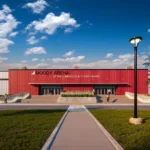
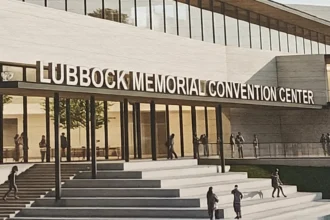
The city subsequently scheduled the Public Meeting on Large-Scale Data Centers for July 7 at the Lubbock Memorial Civic Center. The banquet hall was selected partly because a May town hall about data centers had reached capacity at the Jones AT&T Stadium press box.
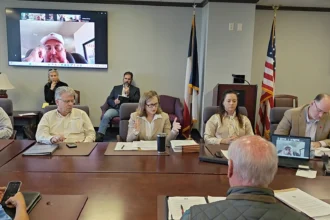
The larger venue proved necessary. Nearly 500 people attended the four-hour special City Council meeting, and about 70 residents spoke. Most opposed large data centers or asked the council to suspend their development, according to KTTZ’s coverage of the meeting.
The turnout showed how quickly data centers have become one of Lubbock’s most contentious development issues.
No project before the council
McBrayer said in June that “quite a few” data-center companies were looking at Lubbock, including locations outside the city limits and properties that could potentially be annexed.
The Lubbock Economic Development Alliance had identified 11 prospective “high-power user” projects, although city officials cautioned that not all were necessarily data centers. A small data center had also begun operating near 19th Street and Avenue Q, while a proposed larger facility in northeast Lubbock was withdrawn after failing to receive support from the Planning and Zoning Commission.
Despite that interest, McBrayer repeatedly said the city had not committed to a developer. As of July 20, the City Council was not considering a specific data-center application inside the city limits, KCBD reported.
The mayor’s stated objective was to create standards before a proposal arrived, preventing the council from having to make policy while simultaneously deciding the fate of an individual development.
Water, electricity and noise dominate concerns
Before the public meeting, approximately 1,550 people completed a city survey. Residents ranked water consumption as their greatest concern, followed by electricity use and potential effects on utility costs, then environmental impact.
Noise, light pollution, transparency, location and possible tax incentives were also among the issues identified.
City Manager Jarrett Atkinson’s presentation on large-scale data centers proposed defining such a facility as one that uses at least 100 megawatts of electricity or 100,000 gallons of water per day and primarily provides information processing or storage for off-site users.
The definition would distinguish hyperscale developments from the smaller data rooms used by hospitals, schools and ordinary businesses.
City staff said Lubbock’s water system has approximately 71.35 million gallons of daily capacity, compared with average demand of about 36.5 million gallons and peak demand of roughly 50.2 million. Staff also noted that total city water consumption declined from 15.3 billion gallons in 2011 to 13.3 billion in 2025 despite population growth.
Opponents questioned whether a hypothetical use of 100,000 to 110,000 gallons per day accurately reflected the demands of a large AI facility. They argued that water needs vary dramatically depending on a project’s size, cooling technology and on-site power generation. Several residents said developers should be required to provide detailed, independently verifiable consumption estimates.
Electricity presented a different challenge. Lubbock can regulate land use and negotiate infrastructure agreements, but it does not control ERCOT, statewide electric policy or state tax incentives. Air-quality permits are also primarily handled by state and federal regulators.
City staff proposes restrictions
Assistant City Manager Erik Rejino presented a draft set of development standards that would use the city’s existing zoning, annexation, utility and contracting authority.
Under the proposal, large data centers would be allowed only in light-industrial or general-industrial districts and would require a specific-use permit. Each project would receive separate public hearings before the Planning and Zoning Commission and City Council.
The suggested standards would also require:
- Closed-loop, air-dry or similar cooling technology designed to minimize continuous withdrawals from the city water system.
- Full disclosure of projected water consumption and payment of a water-reservation fee for capacity held for a project.
- A power study prepared by a licensed engineer.
- Setbacks of at least 300 feet when adjoining other zoning districts and 500 feet for projects with on-site generation.
- Noise studies, sound barriers and a maximum level of 57 decibels at property lines.
- Screening, landscaping, lighting controls and documentation of air-quality compliance.
- A decommissioning plan and letter of credit for facilities with on-site power generation.
The council did not vote on those recommendations at the July 7 meeting. They remain policy proposals rather than enacted requirements.
Officials cite possible financial benefits
City leaders also presented the economic argument for allowing carefully regulated facilities.
Atkinson estimated that every $100 million in taxable property value generates approximately $472,000 annually for city services. In a hypothetical example, staff calculated that a $750 million data center could provide about $3.27 million in annual net property-tax revenue after estimated police, fire, animal-services and code-enforcement costs.
That calculation was not a forecast for an actual project. It also did not account for possible incentives or changes in taxable value.
McBrayer argued that large industrial properties can add considerable tax value without requiring the miles of streets, alleys and neighborhood infrastructure associated with residential development. Opponents responded that tax revenue would not compensate for unacceptable effects on water supplies, electric rates, air quality or residents’ quality of life.
Moratorium campaign continues
A citizen group has been collecting signatures for an 18-month moratorium on data-center development. If enough signatures are verified, the City Council would have to adopt the proposal or send it to voters.
McBrayer said he did not favor a moratorium because city officials were already studying sound limits, setbacks, special permits and utility protections. Supporters of the pause argued that those efforts should be completed before any application can move forward.
The debate also highlights a limit on city authority: Lubbock can impose zoning and utility conditions inside its boundaries, but it has much less control over projects built in unincorporated areas. A facility outside the city could potentially rely on groundwater wells while remaining beyond municipal zoning rules.
The July meeting did not settle whether Lubbock should welcome, restrict or reject large data centers. It did, however, establish that any future proposal will face extensive public scrutiny—and that water, power costs and enforceable protections will be central to the decision.